
Journal of Global Public Health and Healthcare Innovation (Annual (One issue per year))

ABSTRACT
Background
Flaviviral diseases, including dengue, West Nile virus, Zika virus, yellow fever and Japanese encephalitis, remain significant public-health threats in tropical and subtropical settings. Severe disease frequently involves dysregulated inflammation, oxidative stress, endothelial dysfunction and vascular injury, creating an opportunity for host-directed phytomedicinal interventions. Gongronema latifolium Benth, a West African edible and medicinal plant, has demonstrated antioxidant, anti-inflammatory and immunomodulatory activity in experimental models.
Objective
This narrative review evaluates whether the phytochemical and immunopharmacological profile of G. latifolium provides a scientifically plausible, testable rationale for its investigation as a host-directed candidate in flaviviral diseases, with dengue virus infection as the primary disease model.
Methods
A narrative synthesis was conducted in accordance with the SANRA framework of three bodies of evidence: flaviviral disease biology and host-response pathophysiology; G. latifolium phytochemistry and pharmacology; and plant-extract and phytochemical studies in dengue, West Nile virus and related flaviviral systems. Literature was identified via PubMed/MEDLINE, Scopus, Web of Science, Google Scholar and WHO IRIS up to April 2025.
Conclusion
The available evidence supports plausibility, not proof. G. latifolium’s strongest current rationale is immunomodulatory and antioxidant rather than directly antiviral. Direct anti-flaviviral activity has not been demonstrated and must be empirically tested. A rigorous future research programme should combine extract standardisation, compound profiling, cytotoxicity testing, antiviral assays, cytokine and redox endpoints, NS1-focused host-response experiments and toxicity studies. If conducted carefully, G. latifolium could emerge as a credible Nigeria-relevant candidate for flaviviral host-response research rather than a loosely claimed herbal remedy.
Keywords: Gongronema Latifolium; Dengue Virus; Flavivirus; Host-Directed Therapy; Immunomodulation; Phytomedicine; Oxidative Stress; Narrative Review
INTRODUCTION
Flaviviruses are enveloped, positive-sense RNA viruses of substantial public-health importance. Dengue virus (DENV), West Nile virus (WNV), Zika virus (ZIKV), yellow fever virus (YFV) and Japanese encephalitis virus (JEV) all belong to the family Flaviviridae, although they differ in vector ecology, host range, tissue tropism, clinical outcomes and geographical distribution [1-4]. DENV is the most suitable primary model for a review on host-directed phytomedicine because it produces a large global burden, lacks a widely used curative antiviral therapy, and severe disease is shaped by inflammatory, vascular, haematological and oxidative mechanisms rather than by viral replication alone [1,3,5-7].
The clinical importance of dengue has grown sharply in recent decades. WHO reports that dengue is now endemic in more than 100 countries, with recent years showing very high numbers of notified infections [1]. In Nigeria and other African settings, dengue is often under-recognised because acute fever may be treated presumptively as malaria, while laboratory confirmation and serotype-level surveillance are uneven [8-10]. Molecular detection of DENV-1 and DENV-3 among febrile patients in Lagos supports the local relevance of DENV-1 and strengthens the rationale for Nigeria-centred dengue research [8].
WNV provides an important complementary comparison because it is another mosquito-borne flavivirus but has a different bird-Culex-bird ecology and a distinctive neuroinvasive disease pattern. Most human WNV infections are asymptomatic or mild, yet a small proportion progress to meningitis, encephalitis or acute flaccid paralysis, often with long-term neurological consequences [11-12]. ZIKV, YFV and JEV also remain relevant to a flaviviral review because they illustrate how different flaviviruses can share molecular architecture but produce different public-health outcomes, including congenital disease, haemorrhagic disease and encephalitis [2,4,13].
A central challenge in flaviviral therapeutics is that severe disease is frequently driven by host-response dysregulation. DENV pathogenesis involves innate immune activation, cytokine production, complement pathways, platelet changes, endothelial dysfunction, non-structural protein 1 (NS1)-mediated vascular effects and oxidative stress [14-23]. WNV neuroinvasive disease likewise involves immune-cell trafficking, cytokine responses, barrier disruption and neuroinflammatory injury [12,24-25]. This creates an opportunity for host-directed interventions that do not necessarily kill the virus directly but may reduce excessive inflammatory and oxidative injury while preserving antiviral defence.
Gongronema latifolium Benth., commonly known in parts of Nigeria as utazi, is an edible leafy plant with ethnomedicinal importance in West Africa. Existing studies have reported nutritional value, antimicrobial effects, antioxidant activity, anti-inflammatory properties, immunomodulatory effects and safety data in animal models [26-34]. However, the question of whether G. latifolium can positively modulate flaviviral disease remains largely untested. The review therefore does not claim that G. latifolium is a proven anti-dengue or anti-WNV therapy. Instead, it asks whether its phytochemistry and known host-response effects create a credible, testable rationale for flaviviral immunomodulation.
The key argument of this review is comparative. If G. latifolium contains phytochemical classes such as phenolics, flavonoids, tannins, saponins, alkaloids and glycosides, and if related plant extracts or purified phytochemicals have shown anti-DENV, anti-WNV, anti-ZIKV or cytokine-modulating effects, then a carefully designed flavivirus-focused G. latifolium research programme is justified [35-41]. The argument remains a hypothesis-generating rationale, not a conclusion of clinical efficacy.
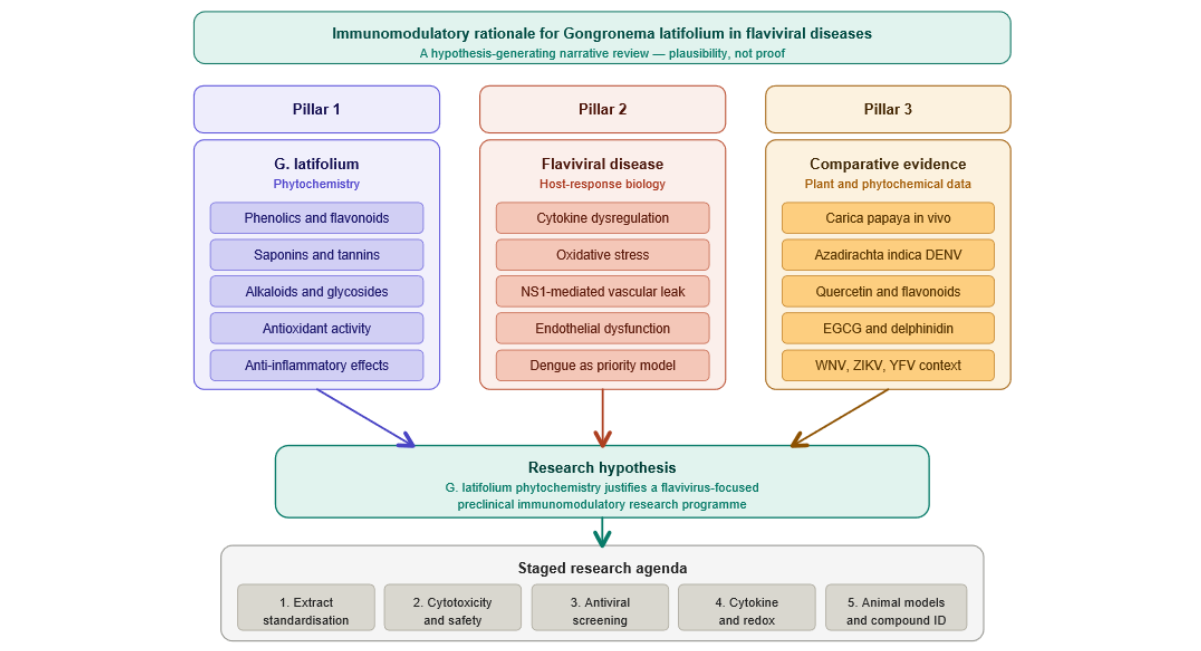
The three-pillar evidence framework guiding the review is summarised in Fig. 1, which should appear here.
Figure 1: Graphical abstract: three-pillar evidence framework linking G. latifolium phytochemistry, flaviviral disease biology and comparative plant evidence to a hypothesis-generating research rationale for host-directed immunomodulation.
Scope of this review
This manuscript is a narrative review rather than a systematic review. It synthesises three bodies of evidence: the public-health and host-response biology of flaviviral diseases; the phytochemistry and immunopharmacology of G. latifolium; and previous studies of plant extracts or plant-derived phytochemicals in DENV, WNV, ZIKV and related flaviviral systems. The goal is to build a scientifically cautious rationale for future research rather than to present G. latifolium as an established antiviral medicine.
The review gives priority to dengue because it is the most common human flaviviral disease and because dengue pathogenesis provides clear endpoints for evaluating plant-based immunomodulation: TNF-alpha, IL-6, IL-10, interferon pathways, platelet-related outcomes, NS1-mediated vascular effects, liver involvement and oxidative stress [1,14,20-21,23,42-45]. WNV is used as a second major example because of its neuroinvasive potential and because WNV NS1 and circulating inflammatory mediators are relevant to tissue spread and central nervous system outcomes [11-12,24-25,46]. ZIKV, YFV and JEV are included selectively where natural-product or flavivirus biology evidence helps generalise the argument.
Chikungunya is an important arbovirus and sometimes appears in the same clinical and public-health conversations as dengue, especially in febrile illness surveillance. However, it is an alphavirus, not a flavivirus. In this review, chikungunya is mentioned only where plant-extract studies evaluate both dengue and chikungunya as arboviruses; it is not used as evidence for flavivirus taxonomy. [5,47].
Review Methodology
This narrative review was conducted in accordance with the SANRA (Scale for the Assessment of Narrative Review Articles) framework. A literature search was conducted up to April 2025 across PubMed/MEDLINE, Scopus, Web of Science, Google Scholar and WHO IRIS using the following primary search terms: “Gongronema latifolium”, “dengue virus”, “West Nile virus”, “Zika virus”, “flavivirus”, “host-directed therapy”, “immunomodulation”, “phytomedicine”, “plant extract antiviral”, “phenolics flavonoids dengue”. Terms were combined with Boolean operators (AND, OR, NOT) as required. Peer-reviewed primary research articles, systematic reviews and narrative reviews in English were eligible for inclusion. Grey literature was restricted to institutional documents from WHO, CDC and ICTV. Articles without accessible abstracts and unreviewed preprints were excluded. No date restriction was applied to foundational G. latifolium pharmacology studies; for comparative flaviviral phytomedicine evidence, publications from 2000 onward were prioritised. All references were verified against their original sources; one citation was identified as published by a non-indexed publisher, this immunological citation was not used as a major evidence pillar; where possible, indexed G. latifolium studies were prioritised, particularly those reporting antioxidant, inflammatory and toxicity-related endpoints [32-33].
Flaviviral diseases and host-directed phytomedicine research
Flaviviral infection begins with viral entry, translation of a single polyprotein, replication in membranous intracellular compartments, assembly and secretion of virions. These replication events are important antiviral targets, but severe flaviviral disease cannot be explained by viral replication alone [2,5,14,45]. In dengue, severe disease is associated with endothelial dysfunction, plasma leakage, platelet changes, complement activation, immune memory, antibody-dependent enhancement in some settings and dysregulated cytokine responses [3,14,23,45].
The secreted flaviviral NS1 protein provides a clear example of host-facing viral biology, including roles in immune evasion and tissue-specific injury [48]. DENV NS1 can trigger endothelial permeability and vascular leak in experimental systems, and additional work links DENV NS1 to MIF-mediated vascular leakage, endothelial glycocalyx degradation and cytokine-independent barrier disruption [15-19]. In WNV, circulating NS1 levels have been shown to influence spread to the brain in mice [46]. These findings imply that host-response modulation is a legitimate research target, especially when the intended intervention is not a conventional virus-directed polymerase or protease inhibitor.
Inflammation and oxidative stress are particularly relevant. Systematic and narrative evidence links oxidative/nitrosative stress to dengue pathogenesis, and oxidative stress can intensify cytokine signalling, lipid peroxidation and tissue injury [20-21]. TNF-alpha, IL-6, interferon-related responses and chemokines have also been associated with dengue severity or WNV neuroinflammatory disease [22,24-25,42]. A plant with credible antioxidant and anti-inflammatory properties could therefore be explored as a host-directed modifier of flaviviral pathophysiology. A host-directed approach is attractive but risky if framed poorly. In viral infection, inflammation is not simply harmful; it is also essential for antiviral defence. Type I interferon responses, antigen presentation, antibody production and cytotoxic responses are necessary to restrict flaviviral replication and dissemination [12,14,22]. Therefore, the desired effect of a plant extract is not indiscriminate immune suppression. The desired effect is balanced modulation: reducing excessive inflammatory and oxidative injury without weakening protective antiviral responses.
This distinction matters for G. latifolium. Reports of anti-inflammatory, antioxidant or immunomodulatory activity support plausibility, but they do not automatically prove benefit in DENV or WNV infection. In some models, reducing TNF-alpha or IL-6 could be beneficial; in others, excessive suppression could impair viral clearance. Thus, future experiments should measure viral load, cytokines, oxidative stress and tissue injury together, rather than using one inflammatory marker as proof of therapeutic benefit.
Phytochemistry of Gongronema latifolium: what has been identified and why it matters
The biological plausibility of G. latifolium begins with its chemical profile. Eleyinmi reported the chemical composition and antibacterial activity of G. latifolium leaves and showed that aqueous and methanol extracts could inhibit selected bacterial pathogens [26]. Subsequent phytochemical screening of aqueous and ethanolic leaf and stem extracts reported alkaloids, flavonoids, saponins, tannins, steroids, glycosides and phenolic compounds in varying quantities [27]. Other studies and reviews similarly describe G. latifolium as a source of phenolics, flavonoids and other secondary metabolites with antioxidant or pharmacological relevance [28,31,35].
The repeated identification of phenolics and flavonoids is particularly important for flavivirus research. Phenolic compounds and flavonoids are widely investigated for antioxidant and antiviral properties, and anti-DENV literature includes several flavonoids and phenolic derivatives as candidates against viral entry, replication, protease activity or virus-induced host injury [35-38]. However, the presence of a phytochemical class in G. latifolium does not mean that the exact same active compound, concentration or bioavailability is present. The correct inference is chemical plausibility, not equivalence.
Saponins and tannins may also contribute to the biological rationale. Saponins can interact with membranes and immune responses, while tannins and other polyphenols may contribute to antioxidant and protein-binding activities. Alkaloids and glycosides add further chemical diversity, but their specific relevance to flaviviral replication or host-response modulation in G. latifolium has not been sufficiently tested. Because plant chemistry changes with part used, solvent, harvest location, processing and extraction conditions, a future G. latifolium-flavivirus study should not rely only on general literature claims. It should chemically characterise the actual extract batch used in the biological experiment [27,35]. Critically, this characterisation should be quantitative rather than qualitative. Conventional colorimetric screening reports only the presence or absence of broad phytochemical classes and cannot support dose-response reasoning, cross-batch comparison or compound-level mechanistic attribution. Future work should therefore report total phenolic and total flavonoid content, quantify defined marker compounds against authenticated reference standards, and generate an HPLC or LC-MS/MS chromatographic fingerprint for every extract batch entering a biological assay, so that any observed antiviral or immunomodulatory effect can be linked to a measurable chemical profile and independently reproduced.
The main phytochemical classes reported in G. latifolium and their relevance to flaviviral host-response hypotheses are summarised in Table 1, which should appear here.
|
Phytochemical class |
Reported in G. latifolium literature |
Potential relevance to flaviviral disease models |
Interpretive caution |
|
Phenolics |
Reported in phytochemical and composition studies of leaves and other plant parts [26-27,35] |
May contribute antioxidant effects and may overlap with phenolic anti-DENV literature [38] |
Requires quantitative phenolic content and compound-level identification. |
|
Flavonoids |
Reported among secondary metabolites in aqueous/ethanolic extracts [27] |
Flavonoids such as quercetin and related molecules have been investigated against DENV and ZIKV [37,49,50] |
The class is broad; activity of quercetin does not prove activity of crude G. latifolium. |
|
Saponins |
Detected in several phytochemical screenings [27] |
May influence immune signalling and membrane-associated processes; useful for host-response hypotheses. |
Can be irritant or cytotoxic at high concentrations; toxicity profiling is necessary. |
|
Tannins |
Reported in leaf/stem extracts [27] |
Could contribute antioxidant and protein-binding effects relevant to inflammation and oxidative stress. |
High tannin content may affect digestibility or assay interference. |
|
Alkaloids |
Reported variably in screenings [27] |
Chemical diversity may provide antiviral or immunological leads. |
Specific alkaloids in the working extract must be identified before mechanistic claims. |
|
Glycosides/steroids/terpenoids |
Reported in some screenings [27] |
May contribute to multi-target pharmacology in crude extracts. |
Presence/absence can vary by solvent and plant part. |
Table 1: Main phytochemical classes reported in Gongronema latifolium and their relevance to flaviviral host-response hypotheses.
Pharmacological evidence for Gongronema latifolium relevant to flaviviral immunomodulation
Antioxidant and redox-modulating evidence
A central reason for considering G. latifolium in flaviviral disease is its antioxidant profile. Ugochukwu and Babady reported antioxidant effects of G. latifolium in hepatocytes from rat models of non-insulin-dependent diabetes mellitus [30]. Ojo and colleagues later reported that G. latifolium leaf extract modulated hyperglycaemia, redox imbalance and inflammation in alloxan-induced diabetic nephropathy [31]. These are not flavivirus studies, but they demonstrate that the plant can influence oxidative and inflammatory processes in vivo.
This is relevant because dengue pathogenesis includes oxidative/nitrosative stress and lipid peroxidation, while oxidative stress may reinforce inflammatory signalling and tissue injury [20-21]. If G. latifolium reduces malondialdehyde or supports antioxidant defences such as superoxide dismutase, catalase and glutathione in non-viral models, those endpoints can reasonably be tested in DENV or WNV models. Still, translation should be treated as a hypothesis. A diabetic nephropathy model does not automatically predict efficacy in acute viral infection.
Anti-inflammatory and immunomodulatory evidence
Morebise and colleagues reported anti-inflammatory activity in G. latifolium leaves, providing early pharmacological support for inflammation-focused studies [29]. Agwaramgbo and colleagues evaluated antioxidant, immunomodulatory activities and safety of G. latifolium fruit, supporting the broader idea that the plant can influence immune-related endpoints [28]. Rowaiye and colleagues reported that aqueous G. latifolium leaf extract affected IFN-γ, IL-10 and immune-cell surface markers in rabbits, while a related study by this group described effects on TNF-α, TGF-β and hepatic enzymes without obvious hepatotoxicity over the reported observation period [32-33]. Parallel work documented suppression of inflammatory markers including IL-6 alongside redox-relevant outcomes in an experimental nephropathy model [31]. These findings support the plausibility of testing G. latifolium in flavivirus-specific cytokine assays.
These findings are valuable because the flaviviral diseases of interest involve cytokine balance. In dengue, TNF-alpha, IL-6 and chemokines can contribute to vascular and systemic inflammation, while IL-10 can indicate counter-regulatory immune activity or immune dysregulation depending on context [22-23,14,42-43]. In WNV, cytokine and chemokine responses are implicated in neuroinvasive disease and tissue injury [12,24-25]. Therefore, a plant extract capable of modifying TNF-alpha, IL-10 or IFN-gamma deserves flavivirus-specific testing.
The current evidence should not be overread. None of the available G. latifolium immunomodulatory studies proves that the plant prevents dengue haemorrhage, reduces WNV neuroinvasion or inhibits flavivirus replication. The stronger claim is narrower: the plant has demonstrated enough antioxidant and immune-modulating activity to justify controlled flavivirus-model experiments.
Safety and dose-related considerations
Safety is central to any plant-derived immunomodulatory argument. A plant consumed traditionally may still have dose-dependent toxicity when concentrated as an extract. Al-Hindi and colleagues reported a 90-day oral toxicity study of ethanolic G. latifolium leaf extract in Sprague Dawley rats [34]. Agwaramgbo and colleagues also included safety-related observations in their evaluation of G. latifolium fruit fractions [28]. For new flavivirus-focused work, safety assessment should include acute toxicity, repeated-dose observations, liver enzymes, kidney markers, body weight, behaviour and histology where feasible.
The Lorke method remains a commonly cited approach for practical acute toxicity testing in experimental pharmacology [51]. It may be useful as a preliminary safety step before more detailed subacute or chronic toxicity studies. However, acute toxicity alone cannot establish safety in viral disease, because infection, inflammation and co-administered treatments can change host physiology.
The main G. latifolium evidence base and the limits of what each source supports are summarised in Table 2, which should appear here.
|
Evidence area |
Key literature |
What it supports |
What it does not prove |
|
Chemical composition/phytochemistry |
Presence of multiple phytochemical classes, including phenolics/flavonoids in some extracts. |
Does not identify a flavivirus-specific active principle. |
|
|
Antioxidant/redox activity |
Plausibility for testing oxidative-stress endpoints such as MDA, SOD, catalase and GSH. |
Does not prove anti-DENV or anti-WNV efficacy. |
|
|
Anti-inflammatory activity |
Morebise et al. [29] |
Supports inflammation-focused rationale. |
Does not define optimal dose or cytokine direction in viral infection. |
|
Immunomodulatory activity |
Supports testing TNF-alpha, IL-6, IL-10, IFN-related and immune-cell endpoints. |
Does not prove benefit in flavivirus infection. |
|
|
Toxicity/safety |
Supports inclusion of safety and toxicity endpoints. |
Does not replace disease-model safety assessment. |
Table 2: Relevant G. latifolium evidence and what it supports.
Comparative evidence from plant extracts and phytochemicals in flaviviral research
The argument for G. latifolium becomes stronger when its phytochemical classes are compared with plant-extract and plant-derived compound studies in DENV and other flaviviruses. This comparative evidence does not prove that G. latifolium will work, but it shows that the general scientific pathway is credible: plants and their secondary metabolites can influence viral entry, replication, protease function, cytokine production, platelet biology or oxidative injury in flavivirus-related models [38-41].
One of the most relevant in vivo dengue examples is Carica papaya. Freeze-dried C. papaya leaf juice has been studied in DENV-infected AG129 mice, where investigators assessed inflammatory cytokine production and immunomodulatory effects [35-36]. This is important for G. latifolium because it shows that plant-based dengue research can move beyond folklore into controlled animal models with cytokine endpoints. C. papaya is not chemically identical to G. latifolium, but the experimental logic is transferable: standardised plant material, dengue infection model, cytokine measurement, haematological endpoints and cautious interpretation.
Azadirachta indica provides another useful precedent. Parida and colleagues reported in vitro and in vivo inhibitory potential of aqueous neem leaf extract and azadirachtin against DENV-2 replication [52]. This example is significant because it used an aqueous plant preparation, which is relevant to traditional medicine and to the proposed use of aqueous G. latifolium extracts. Again, it does not show that G. latifolium is antiviral; it shows that aqueous plant extracts can be studied against DENV with virological endpoints.
Ficus septica is a useful in vitro example because screening of 59 crude extracts from 23 plants identified methanol extracts from fruit, heartwood, leaves and stem with anti-DENV-1 and anti-DENV-2 effects without cytotoxicity at the tested conditions [53]. This kind of screening provides a model for early-stage G. latifolium work: test multiple extract fractions, screen cytotoxicity, measure DENV inhibition by serotype and avoid assuming that crude extract activity will translate directly to clinical effect.
Houttuynia cordata and its constituents offer a phytochemical bridge. H. cordata extract, quercetin, quercetrin and cinanserin were evaluated against DENV infection, and the ethyl acetate fraction was reported to contribute to antiviral efficacy without cytotoxicity in vitro or acute toxicity in vivo [54]. Quercetin-related evidence is relevant because G. latifolium contains flavonoid classes, but it should be used carefully: detection of flavonoids in G. latifolium does not mean quercetin is present at active concentrations unless chemically verified.
Andrographis paniculata also provides anti-DENV precedent. Ramalingam and colleagues reported anti-dengue activity of A. paniculata extracts and quantified viral inhibition by SYBR green RT-PCR, with the medicinal plant showing substantial inhibition in their assay system [55]. The key lesson is methodological: plant extracts should be assessed using quantitative virological assays, not only general symptom or antioxidant endpoints.
Purified phytochemicals further strengthen the rationale. Zandi and colleagues showed that selected bioflavonoids had antiviral activity against DENV-2 [49]. Vázquez-Calvo and colleagues reported that natural polyphenols, particularly delphinidin and epigallocatechin gallate, had antiviral activity against WNV, ZIKV and DENV in cell culture, with evidence suggesting virucidal effects on virus particles [56]. Reviews of phenolic compounds and natural products against arboviruses also identify plant-derived molecules as multi-target antiviral candidates [38-39]. The relevance to G. latifolium is the phytochemical overlap in broad classes, not proof of identical activity.
Selected comparative plant-extract and phytochemical evidence relevant to the G. latifolium-flavivirus rationale is presented in Table 3, which should appear here.
|
Plant/compound |
Flavivirus or model |
Reported outcome |
How it informs G. latifolium research |
|
Carica papaya leaf juice |
DENV-2 infected AG129 mice |
Modulated inflammatory cytokines and immune-related responses [43-44] |
Shows that plant-based dengue immunomodulation can be tested in vivo. |
|
Azadirachta indica aqueous leaf extract/azadirachtin |
DENV-2 |
Reported inhibition of DENV-2 replication in vitro and in vivo [52] |
Provides precedent for aqueous plant preparations against DENV. |
|
Ficus septica extracts |
DENV-1 and DENV-2 in vitro |
Promising anti-DENV activity from selected extracts [53] |
Supports extract screening and serotype-specific testing. |
|
Houttuynia cordata extract, quercetin, quercetrin |
DENV infection models |
Reported anti-DENV activity with attention to cytotoxicity and toxicity [54] |
Connects flavonoid-rich plant extracts to anti-DENV hypotheses. |
|
Andrographis paniculata extracts |
DENV in vitro |
Reported viral inhibition measured by RT-PCR [55] |
Demonstrates need for quantitative virological endpoints. |
|
Bioflavonoids including quercetin-related compounds |
DENV-2 |
Antiviral activity against DENV-2 [49] |
Reinforces flavonoid-focused mechanistic screening. |
|
Delphinidin and EGCG |
WNV, ZIKV and DENV |
Inhibited flavivirus infectivity in cell culture [56] |
Supports cross-flavivirus relevance of polyphenols. |
|
Natural product reviews |
Arboviruses including DENV/WNV/ZIKV |
Summarise multi-target antiviral activity of plant products [38-39,41] |
Provides context but not plant-specific proof. |
Table 3: Selected plant extract and phytochemical evidence relevant to a G. latifolium-flavivirus rationale.
Mechanistic bridge: how G. latifolium could plausibly affect flaviviral disease biology
Antiviral plausibility: possible but currently unproven
The possibility of direct antiviral activity should be framed as a testable hypothesis. Plant-derived phenolics and flavonoids may interfere with viral attachment, entry, envelope integrity, protease activity, polymerase function or viral assembly, depending on the compound and virus [36-39,49,57]. Several anti-DENV studies have focused on entry, NS2B/NS3 protease, viral RNA reduction or plaque/infectivity outcomes [38,40,49,53-55]. If G. latifolium contains relevant phenolics or flavonoids, it may contain compounds worthy of anti-DENV screening.
However, direct antiviral activity should not be assumed. The current G. latifolium literature is stronger for antioxidant, anti-inflammatory and immunomodulatory properties than for direct anti-flaviviral replication. Therefore, the most defensible wording is that G. latifolium may have antiviral potential if its constituents can interfere with DENV or WNV entry, replication or NS protein function, but this has to be demonstrated using cell-culture assays, viral RNA quantification, plaque/focus assays, cytotoxicity controls and time-of-addition experiments.
Immunomodulatory plausibility: currently the strongest argument
The stronger argument for G. latifolium is immunomodulatory. Severe dengue is associated with cytokine dysregulation, vascular changes and inflammatory amplification, while WNV neuroinvasive disease involves inflammatory responses that can shape barrier function and neurological injury [14,22-25,42]. G. latifolium has been reported to influence immune markers such as IFN-gamma, IL-10, TNF-alpha-related responses and immune-cell markers in non-flaviviral models [28,31-32]. This overlap provides a plausible rationale for testing whether the plant reduces excessive inflammation or promotes balanced regulation in DENV or WNV models.
A desirable immunomodulatory effect in dengue would not be a simple reduction of all cytokines. A more credible pattern would include reduction of excessive TNF-alpha and IL-6, preservation of antiviral interferon signalling where needed, and appropriate regulation of IL-10 rather than uncontrolled anti-inflammatory dominance. Because cytokines can have protective and pathogenic roles, future work must interpret cytokine changes in relation to viral burden, clinical signs, platelet indices, vascular markers and tissue damage. This dual-edged character warrants explicit statement. Attenuation of excessive TNF-alpha and IL-6 may plausibly limit endothelial activation, plasma leakage and tissue injury, whereas suppression that is too deep or mistimed, particularly during the early viraemic phase, could blunt type I interferon signalling and delay viral clearance, converting an apparent anti-inflammatory benefit into a net harm. The therapeutic target is therefore recalibration of a dysregulated host response within a defined window, not global immunosuppression. Accordingly, a reported reduction in inflammatory mediators without concurrent viral-burden and safety data should be treated as uninterpretable rather than as evidence of benefit.
Antioxidant and vascular-protective plausibility
DENV infection and severe dengue are linked with oxidative/nitrosative stress, and oxidative injury may interact with endothelial dysfunction and inflammatory signalling [20-21,23]. DENV NS1 can disrupt endothelial barrier function and glycocalyx integrity, while WNV disease can involve barrier-related neuroinvasion and inflammatory injury [16-19,46]. G. latifolium antioxidant evidence therefore supports testing markers such as MDA, SOD, catalase, glutathione and nitric oxide-related endpoints in flaviviral models [30-31,51,58].
This does not mean that G. latifolium will prevent plasma leakage or neuroinvasion. It means that the plant has a biologically plausible redox profile worth testing in systems where oxidative stress and barrier injury are measurable. If an extract reduces MDA while preserving antioxidant enzymes and reducing excessive cytokine expression, the result would support host-response modulation. If it reduces viral load as well, the case for dual antiviral and immunomodulatory activity would become stronger.
The mechanistic hypotheses linking G. latifolium phytochemistry to flaviviral disease biology are presented in Table 4, which should appear here.
|
Hypothesis |
Supporting basis |
Best future endpoint |
Risk of overstatement |
|
Direct antiviral inhibition |
Phenolics/flavonoids from other plants inhibit DENV/WNV/ZIKV in vitro [38,51, 53-5453-54,56] |
Viral RNA, plaque/focus assay, time-of-addition, NS2B/NS3 protease assay |
Do not claim until G. latifolium is tested directly. |
|
Reduced excessive cytokine response |
G. latifolium affects immune markers in animal studies [28,32-33] |
TNF-alpha, IL-6, IL-10, IFN-beta/gamma, chemokines |
Suppression may be harmful if antiviral defence is impaired. |
|
Antioxidant protection |
G. latifolium reduces redox imbalance in non-viral models [30-31] |
MDA, SOD, catalase, GSH, total antioxidant capacity |
Antioxidant effect in diabetes does not equal dengue protection. |
|
Endothelial or barrier support |
DENV NS1 and WNV inflammation affect barrier biology [16-19,46] |
Endothelial permeability assays, glycocalyx markers, vascular leak models |
No direct proof yet for G. latifolium on flaviviral barrier injury. |
|
Safety-compatible host modulation |
Toxicity studies provide preliminary safety basis [28,34,51] |
LD50/acute toxicity, ALT/AST/ALP, urea/creatinine, histology |
Traditional use does not replace toxicity testing. |
Table 4: Mechanistic hypotheses linking G. latifolium phytochemistry to flaviviral disease biology.
Dengue virus as the priority disease model
Dengue should be the priority model for future G. latifolium-flavivirus research for five reasons. First, it has the largest global disease burden among human flaviviruses and is highly relevant to tropical public health [1,45]. Second, dengue has documented Nigerian relevance, including molecular detection of DENV-1 and DENV-3 in Lagos [9-10]. Third, severe dengue has measurable host-response endpoints that match G. latifolium pharmacology: cytokines, oxidative stress, thrombocytopenia, liver enzymes and vascular injury [12-14,52]. Fourth, DENV NS1 is a host-interacting protein with established links to endothelial dysfunction [6-10]. Fifth, there is a growing body of anti-dengue plant literature against which G. latifolium can be compared [31,33-41].
The initial dengue research strategy should include both host-directed and virus-directed endpoints. An extract that only reduces cytokines but does not reduce viral burden may still be useful as an adjunctive immunomodulator, but it must be shown not to worsen infection. Conversely, an extract that reduces viral RNA but causes liver enzyme elevation or severe immunosuppression would not be acceptable. Therefore, dengue models should integrate antiviral, immunological and safety endpoints from the beginning.
A DENV-1 rationale is especially relevant in Nigeria because DENV-1 has been detected in Lagos, but DENV-2 is also important because many anti-dengue plant studies and animal models use DENV-2 [16,35-37,39,41]. A practical research programme could begin with DENV-2 or available laboratory strains for feasibility, but should eventually include DENV-1 if the aim is local serotype relevance.
West Nile virus, Zika virus and other flaviviruses: why they matter as secondary comparisons
WNV is valuable as a secondary comparison because it tests whether the G. latifolium rationale applies beyond dengue vascular disease. WNV pathogenesis includes innate immune control, neuroinvasion, cytokine responses and barrier biology [4-5,11,15,47]. If G. latifolium modulates inflammatory and oxidative responses without impairing antiviral defence, it could be explored in WNV host-response systems. However, neuroinvasive disease requires careful models and should not be inferred from serum cytokines alone.
ZIKV is relevant because flavonoids and natural products have been explored as anti-ZIKV candidates, and polyphenols such as EGCG and delphinidin have shown activity across WNV, ZIKV and DENV in cell culture [56-60]. ZIKV also demonstrates the importance of tissue-specific pathogenesis, including fetal and neurological outcomes, which would require models different from dengue. G. latifolium should not be assumed to affect ZIKV congenital disease, but its broad flavonoid/phenolic rationale may justify preliminary in vitro screening.
YFV and JEV are included mainly for public-health context and mechanistic breadth. YFV remains vaccine-preventable but dangerous where vaccination coverage is insufficient, while JEV is an important cause of viral encephalitis in endemic regions [54-55]. Natural-product evidence for JEV is growing but translating G. latifolium to these viruses would require a stepwise approach, beginning with in vitro safety and antiviral assays [45].
Across all these comparisons, extrapolation must remain deliberately limited. DENV, WNV, ZIKV, YFV and JEV differ in vector ecology, receptor usage, primary target cells and tissue tropism, and these differences produce distinct disease biology: DENV pathology is dominated by NS1-associated endothelial dysfunction and plasma leakage; WNV and JEV cause neuroinvasive disease governed by blood-brain barrier integrity and neuroinflammation; ZIKV involves neural progenitor and placental tropism with congenital consequences; and YFV produces viscerotropic hepatic injury. Because the host compartments at risk differ, an immunomodulatory or redox effect demonstrated in a DENV vascular model cannot be assumed to operate, or to be beneficial, in a neuroinvasive or hepatotropic setting, where the same degree of immune attenuation may be irrelevant or actively harmful. Each flavivirus therefore requires its own disease-appropriate model, endpoints and safety assessment, and the comparative evidence assembled here should be read as hypothesis-generating breadth rather than as transferable efficacy for G. latifolium.
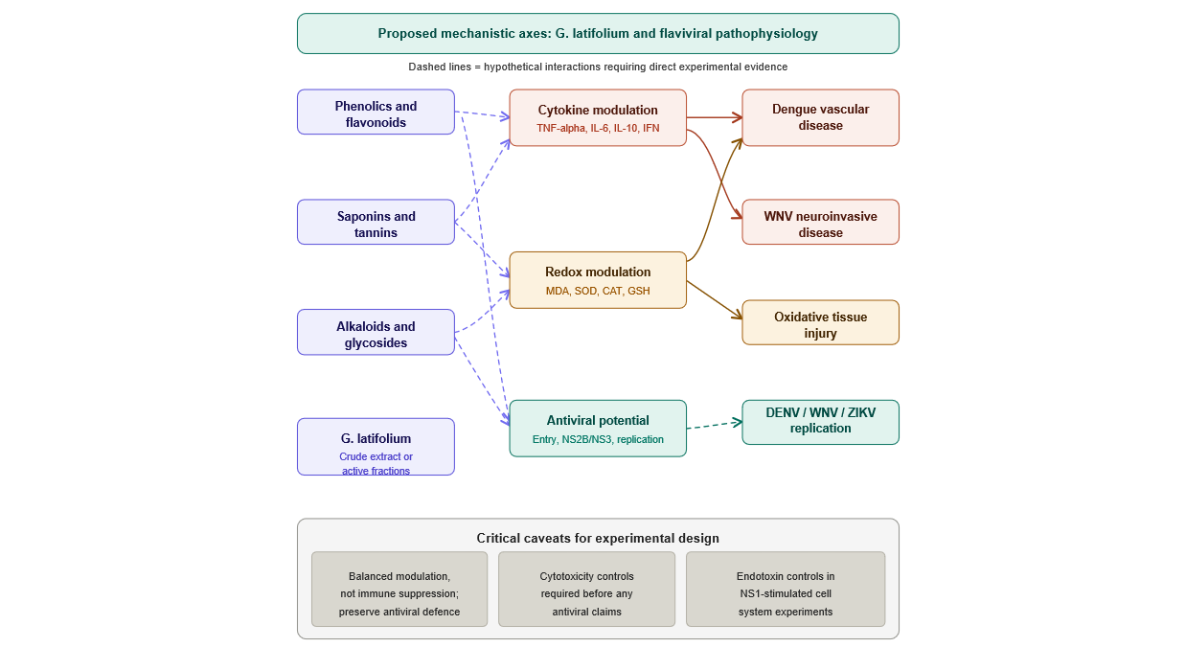
The proposed mechanistic axes connecting G. latifolium phytochemical classes to flaviviral disease biology are shown in Fig. 2, which should appear here.
Figure 2: Proposed mechanistic axes linking G. latifolium phytochemical classes to flaviviral disease biology. Dashed lines indicate hypothetical interactions requiring direct experimental evidence. All three axes (cytokine modulation, redox modulation, antiviral potential) require validation in flavivirus-specific cell and animal models before therapeutic claims can be advanced.
Proposed research model emerging from the review
The evidence supports a staged research agenda. The first stage should standardise G. latifolium plant material and extraction. Leaves should be authenticated, voucher specimens documented and aqueous, ethanol or fractionated extracts prepared with recorded yield. Phytochemical screening should be paired with total phenolic content, total flavonoid content and chromatographic fingerprinting. Chromatographic quantification by HPLC or LC-MS/MS should be treated as a minimum standardisation requirement rather than an optional refinement, with candidate marker compounds quantified against authentic reference standards instead of being reported only as broad phytochemical classes. The resulting fingerprint should be published with the biological data so that the extract tested can be chemically reconstructed by other laboratories.
The second stage should use in vitro cytotoxicity and antiviral assays. Cytotoxicity should be tested in relevant cell lines before antiviral interpretation. Anti-DENV screening should measure viral RNA, infectious virus or viral antigen after pre-treatment, co-treatment and post-entry treatment to distinguish virucidal, entry-inhibitory and replication-phase effects. If resources are limited, NS2B/NS3 protease or NS5 polymerase screening may provide early mechanistic direction, but cell-based confirmation remains essential.
The third stage should test host-response modulation. Infected-cell or NS1-stimulated systems can measure TNF-alpha, IL-6, IL-10, type I interferon-associated markers, NF-kappaB-related signalling and oxidative stress. Endotoxin contamination must be controlled in recombinant-protein studies because residual endotoxin in recombinant proteins can activate innate immune responses and confound cytokine interpretation [58-59].
The fourth stage should use animal models only after in vitro safety and antiviral plausibility are established. DENV-infected AG129 mice, recombinant NS1 exposure models or other approved systems could be used depending on biosafety and institutional capacity. Outcomes should include viral burden where applicable, cytokines, redox markers, liver enzymes, haematology, organ indices and histology. Lorke acute toxicity and repeated-dose toxicity studies should be integrated before efficacy claims are advanced [35-36,60].
The staged future research agenda for testing the G. latifolium-flavivirus hypothesis is summarised in Table 5, which should appear here.
|
Stage |
Purpose |
Minimum outputs |
Decision point |
|
1. Extract standardisation |
Make plant material reproducible |
Voucher number, yield, solvent, batch records, phytochemical profile |
Proceed only with chemically documented extract. |
|
2. Safety/cytotoxicity |
Exclude nonspecific toxicity |
Cell viability, selectivity index, acute toxicity data |
Do not interpret antiviral effect if cytotoxic. |
|
3. Antiviral screening |
Test direct anti-flaviviral effect |
DENV RNA/antigen/infectivity; time-of-addition assay |
Differentiate entry, replication and virucidal activity. |
|
4. Immunomodulatory testing |
Assess host-response modulation |
TNF-alpha, IL-6, IL-10, IFN markers, oxidative markers; interpreted in parallel with viral burden (viral RNA/infectivity) and safety endpoints (viability, haematology, liver enzymes, histology) |
Confirm balanced modulation, not blanket suppression. Cytokine and redox changes must be read simultaneously with viral burden and safety/clinical endpoints; advance only if host-response benefit occurs without increased viral load or toxicity. |
|
5. Animal studies |
Evaluate integrated host response |
Viral burden, cytokines, redox status, liver enzymes, haematology, histology |
Advance only if benefit and safety align. |
|
6. Fractionation and compound ID |
Identify active fraction(s) |
LC-MS/HPLC peaks, bioassay-guided fractions |
Move from crude extract claim to mechanistic evidence. |
Table 5: Future research agenda for testing the G. latifolium-flavivirus hypothesis.
Public-health and African research relevance
The public-health relevance of this review is not that G. latifolium should be promoted immediately as a dengue remedy. Rather, the relevance is that African medicinal plants should be evaluated with modern virology, immunology and toxicology methods. Nigeria and other African countries have substantial burdens of undifferentiated febrile illness, and dengue is likely underdiagnosed in several settings [16-18]. Locally available plants with documented phytochemistry and safety profiles can be prioritised for careful preclinical screening.
A G. latifolium research programme would also be feasible in low-resource immunovirology if designed stepwise. Basic phytochemistry, antioxidant assays, ELISA-based cytokine analysis, liver enzyme measurement and haematology are achievable in many university or research institute settings. More specialised antiviral assays may require collaboration with virology laboratories that can handle DENV or pseudotyped/flaviviral protein systems safely. This collaborative model could generate locally relevant data without overstating traditional medicine claims.
The ethical communication of findings is essential. If G. latifolium shows immunomodulatory activity, it should be described as a candidate requiring further study, not as a cure. If it shows antiviral activity in vitro, it should not be translated directly to human treatment without pharmacokinetic, toxicity and disease-model evidence. Such caution protects the public and strengthens the scientific credibility of ethnomedicine research.
Limitations of the current evidence
Several limitations must be acknowledged. Direct evidence for Gongronema latifolium against DENV, WNV, ZIKV, YFV or JEV remains limited, and the current rationale is largely inferred from its reported phytochemistry, non-flaviviral immunopharmacological effects and comparison with other plant-derived anti-flaviviral studies. This is important because crude plant extracts are chemically complex, and broad phytochemical labels such as flavonoids, phenolics, tannins or saponins are not sufficient to define a precise antiviral or immunomodulatory mechanism.
Immunomodulation is also highly context-dependent: a cytokine-lowering effect may be useful when inflammation is excessive, but it could be harmful if it weakens protective antiviral defence. In the same way, traditional use does not automatically guarantee safety, especially when extracts are concentrated, fractionated or used during acute viral infection. Finally, flaviviruses differ substantially in tropism, immune interactions and disease mechanisms; therefore, an effect observed in DENV-2 cannot automatically be generalised to DENV-1, WNV, ZIKV, YFV or JEV. The relevant host compartment differs across these viruses, so vascular, neurological, placental and hepatic disease models are not interchangeable, and the endpoints that define benefit in one model may not define benefit in another. Quantitative extract standardisation using marker compounds is equally indispensable, because qualitative class-level screening cannot support reproducible cross-study or cross-virus comparison. These limitations reinforce the need for careful extract standardisation, staged experimentation and disease-specific validation before any therapeutic claim is made.
CONCLUSION
The available evidence supports a scientifically plausible but unproven rationale for evaluating Gongronema latifolium as a host-directed immunomodulatory candidate in flaviviral diseases, especially dengue. The rationale rests on three pillars: G. latifolium contains phytochemical classes associated with antioxidant and immunopharmacological activity; experimental studies suggest the plant can influence inflammatory, oxidative and immune-related endpoints; and separate plant-extract and phytochemical studies show that natural products can affect DENV, WNV, ZIKV and related flaviviral processes.
The strongest current argument is immunomodulatory and antioxidant, not direct antiviral. Direct antiviral effects against DENV or WNV should be considered possible but must be tested. A rigorous future research programme should combine extract standardisation, compound profiling, cytotoxicity testing, antiviral assays, cytokine and redox endpoints, NS1-focused host-response experiments and toxicity studies. If such work is done carefully, G. latifolium could become a credible Nigeria-relevant candidate for flaviviral host-response research rather than a loosely claimed herbal remedy.
DECLARATIONS
AUTHOR CONTRIBUTIONS
A.O.A. (Principal Investigator and Senior Researcher): conceptualisation, supervision, writing – review and editing, critical revision. T.U.A: literature search, writing – original draft.
FUNDING
This research received no external funding.
CONFLICTS OF INTEREST
The authors declare no conflicts of interest.
DATA AVAILABILITY STATEMENT
No datasets were generated or analysed during the current study. This manuscript is a narrative review of published literature.
ETHICS STATEMENT
This review did not involve human participants or animal experiments and therefore did not require ethical approval.
LIST OF ABBREVIATIONS
ALP: alkaline phosphatase; ALT: alanine aminotransferase; AST: aspartate aminotransferase; CAT: catalase; CDC: Centers for Disease Control and Prevention; CRediT: Contributor Roles Taxonomy; DENV: dengue virus; DENV-1, DENV-2, DENV-3: dengue virus serotypes 1, 2 and 3; EGCG: epigallocatechin gallate; GSH: glutathione; HPLC: high-performance liquid chromatography; ICTV: International Committee on Taxonomy of Viruses; IFN: interferon; IFN-γ: interferon gamma; IL-6: interleukin-6; IL-10: interleukin-10; JEV: Japanese encephalitis virus; LC-MS: liquid chromatography–mass spectrometry; MDA: malondialdehyde; MIF: macrophage migration inhibitory factor; NF-κB: nuclear factor kappa B; NS1: non-structural protein 1; NS2B/NS3: non-structural proteins 2B and 3; RNA: ribonucleic acid; ROS: reactive oxygen species; RT-PCR: reverse transcription polymerase chain reaction; SANRA: Scale for the Assessment of Narrative Review Articles; SOD: superoxide dismutase; TGF-β: transforming growth factor beta; TNF-α: tumour necrosis factor alpha; WHO: World Health Organization; WNV: West Nile virus; YFV: yellow fever virus; ZIKV: Zika virus.
REFERENCES
- World Health Organization. Dengue and severe dengue. Geneva: World Health Organization; 2025.
- Pierson TC, Diamond MS. The continued threat of emerging flaviviruses. Nat Microbiol. 2020;5:796-812. [Crossref] [Google Scholar]
- World Health Organization. Dengue: guidelines for diagnosis, treatment, prevention and control. Geneva: World Health Organization; 2009.
- World Health Organization. Yellow fever. Geneva: World Health Organization; 2025
- Simmonds P, Becher P, Bukh J, Gould EA, Meyers G, Monath T, et al. ICTV virus taxonomy profile: Flaviviridae. J Gen Virol. 2017;98:2-3. [Crossref] [Google Scholar]
- International Committee on Taxonomy of Viruses. Family Flaviviridae. ICTV Virus Taxonomy Report; 2024.
- Schwarz H, Schmittner M, Duschl A, Horejs-Hoeck J. Residual endotoxin contaminations in recombinant proteins are sufficient to activate human CD1c+ dendritic cells. PLoS One. 2014;9:e113840. [Crossref] [Google Scholar]
- Ayolabi CI, Olusola BA, Ibemgbo SA, Okonkwo GO. Detection of dengue viruses among febrile patients in Lagos, Nigeria and phylogenetics of circulating dengue serotypes in Africa. Infect Genet Evol. 2019;75:103947. [Crossref] [Google Scholar]
- Emeribe AU, Abdullahi IN, Isong IK, et al. Dengue Virus is Hyperendemic in Nigeria from 2009 to 2020: A Contemporary Systematic Review. Infect Chemother. 2021;53(2):284-299. [Crossref] [Google Scholar]
- Ali KB, et al. Prevalence of dengue fever in Nigeria: a scoping review. J Glob Infect Dis. 2025;17(3):124-130. [Crossref] [Google Scholar]
- Centers for Disease Control and Prevention. Clinical signs and symptoms of West Nile virus disease. Atlanta: CDC; 2025.
- Lim SM, Koraka P, Osterhaus ADME, Martina BEE. West Nile virus: immunity and pathogenesis. Viruses. 2011;3:811-828. [Crossref] [Google Scholar]
- Centers for Disease Control and Prevention. About Japanese encephalitis. Atlanta: CDC; 2024.
- Screaton G, Mongkolsapaya J, Yacoub S, Roberts C. New insights into the immunopathology and control of dengue virus infection. Nat Rev Immunol. 2015;15:745-759. [Crossref] [Google Scholar]
- Muller DA, Young PR. The flavivirus NS1 protein: molecular and structural biology, immunology, role in pathogenesis and application as a diagnostic biomarker. Antiviral Res. 2013;98:192-208. [Crossref] [Google Scholar]
- Beatty PR, Puerta-Guardo H, Killingbeck SS, Glasner DR, Hopkins K, Harris E. Dengue virus NS1 triggers endothelial permeability and vascular leak that is prevented by NS1 vaccination. Sci Transl Med. 2015;7:304ra141. [Crossref] [Google Scholar]
- Chen HR, Chuang YC, Lin YS, Liu HS, Liu CC, Perng GC, Yeh TM. Dengue virus nonstructural protein 1 induces vascular leakage through macrophage migration inhibitory factor and autophagy. PLoS Negl Trop Dis. 2016;10:e0004828. [Crossref] [Google Scholar]
- Chen HR, Chao CH, Liu CC, Ho TS, Tsai HP, Perng GC, et al. Macrophage migration inhibitory factor is critical for dengue NS1-induced endothelial glycocalyx degradation and hyperpermeability. PLoS Pathog. 2018;14:e1007033. [Crossref] [Google Scholar]
- Glasner DR, Ratnasiri K, Puerta-Guardo H, Espinosa DA, Beatty PR, Harris E. Dengue virus NS1 cytokine-independent vascular leak is dependent on endothelial glycocalyx components. PLoS Pathog. 2017;13:e1006673. [Crossref] [Google Scholar]
- Castro R, Pinzon HS, Alvis-Guzman N, Mattar S. A systematic review of observational studies on oxidative/nitrosative stress involvement in dengue pathogenesis. Colomb Med. 2015;46:135-143. [Google Scholar]
- Pillai AB, Muthuraman KR, Mariappan V, Belur SS, Lokesh S, Rajendiran S, Subramaniam S. Oxidative stress response in the pathogenesis of dengue virus virulence, disease prognosis and therapeutics: an update. Arch Virol. 2019;164:2895-2908. [Crossref] [Google Scholar]
- Pan Y, et al. Flaviviruses: innate immunity, inflammasome activation, inflammatory cell death, and cytokines. Front Immunol. 2022;13:829433. [Crossref] [Google Scholar]
- Malavige GN, Jeewandara C, Ogg GS. Pathogenesis of vascular leak in dengue virus infection. Immunology. 2017;151:261-269. [Crossref] [Google Scholar]
- Pavesi A, Tiecco G, Rossi L, Sforza A, Ciccarone A, Compostella F, et al. Inflammatory response associated with West Nile neuroinvasive disease: a systematic review. Viruses. 2024;16:383. [Crossref] [Google Scholar]
- Zidovec-Lepej S, Vilibic-Cavlek T, Ilic M, et al. Antiviral cytokine response in neuroinvasive and non-neuroinvasive West Nile virus infection. Viruses. 2021;13:342. [Crossref] [Google Scholar]
- Eleyinmi AF. Chemical composition and antibacterial activity of Gongronema latifolium. J Zhejiang Univ Sci B. 2007;8:352-358. [Crossref] [Google Scholar]
- Ilodibia CV, Ezeja IJ, Akachukwu EE, Chukwuma MU, Egboka TP, Emeka AN. Phytochemical screening and antimicrobial effects of aqueous and ethanol leaf and stem extracts of Gongronema latifolium Benth. Res J Bot. 2015;10:50-60. [Crossref] [Google Scholar]
- Agwaramgbo A, Osuagwu C, Nwankwo C, Ochonogor A. Evaluation of antioxidant, immunomodulatory activities, and safety of Gongronema latifolium fruit. Evid Based Complement Alternat Med. 2014;2014:938424. [Crossref] [Google Scholar]
- Morebise O, Fafunso MA, Makinde JM, Olajide OA, Awe EO. Anti-inflammatory property of the leaves of Gongronema latifolium. Phytother Res. 2002;16 Suppl 1:S75-S77. [Crossref] [Google Scholar]
- Ugochukwu NH, Babady NE. Antioxidant effects of Gongronema latifolium in hepatocytes of rat models of non-insulin dependent diabetes mellitus. Fitoterapia. 2002;73:612-618. [Crossref] [Google Scholar]
- Ojo OA, Ojo AB, Ajiboye BO, Olaiya O, Adeyonu O, Imiere O, et al. Gongronema latifolium leaf extract modulates hyperglycaemia, inhibits redox imbalance and inflammation in alloxan-induced diabetic nephropathy. J Diabetes Metab Disord. 2020;19:469-481. [Crossref] [Google Scholar]
- Rowaiye AB, Njoku MO, Oli AN, Igbokwe NH, Asala T, Salami SA, Uzochukwu IC, Esimone CO. Aqueous leaves extract of Gongronema latifolium (Benth) downregulates the expression of IFN-γ, IL-10 and cell surface markers in rabbits. Open J Med Microbiol. 2022;12(4):117-128. [Crossref] [Google Scholar]
- Rowaiye A, Njoku M, Oli A, Akrami S, Asala T, Uzochukwu I, et al. In vivo Effects of Aqueous Extract of Gongronema latifolium Benth on the Tumor Necrosis Factor-α, Transforming Growth Factor-β, and Hepatic Enzymes. Oncologie. 2021;23(4):547-557. [Crossref] [Google Scholar]
- Al-Hindi B, Yusoff NA, Ahmad M, Atangwho IJ. Safety assessment of the ethanolic extract of Gongronema latifolium Benth. leaves: a 90-day oral toxicity study in Sprague Dawley rats. BMC Complement Altern Med. 2019;19:152. [Crossref] [Google Scholar]
- Tungmunnithum D, Thongboonyou A, Pholboon A, Yangsabai A. Flavonoids and other phenolic compounds from medicinal plants for pharmaceutical and medical aspects: an overview. Medicines. 2018;5:93. [Crossref] [Google Scholar]
- Wang L, Song J, Liu A, Xiao B, Li S, Wen Z, et al. Research progress of the antiviral bioactivities of natural flavonoids. Nat Prod Bioprospect. 2020;10:271-283. [Crossref] [Google Scholar]
- Badshah SL, Faisal S, Muhammad A, Poulson BG, Emwas AH, Jaremko M. Antiviral activities of flavonoids. Biomed Pharmacother. 2021;140:111596. [Crossref] [Google Scholar]
- Loaiza-Cano V, Monsalve-Escudero LM, Filgueira L, et al. Antiviral role of phenolic compounds against dengue virus. Biomolecules. 2021;11(1):11. [Crossref] [Google Scholar]
- Goh VSL, Mok CK, Chu JJH. Antiviral natural products for arbovirus infections. Molecules. 2020;25:2796. [Crossref] [Google Scholar]
- Lim SYM, Chieng JY, Pan Y. Recent insights on anti-dengue virus (DENV) medicinal plants: review on in vitro, in vivo and in silico discoveries. All Life. 2021;14(1):1-33. [Crossref] [Google Scholar]
- Altamish M, Khan M, Baig MS, Pathak B, Rani V, Akhtar J, Khan AA, Ahmad S, Krishnan A. Therapeutic Potential of Medicinal Plants against Dengue Infection: A Mechanistic Viewpoint. ACS Omega. 2022;7:24048-24065. [Crossref] [Google Scholar]
- Masood KI, Jamil B, Rahim M, Islam M, Farhan M, Hasan Z. Role of TNF-alpha, IL-6 and CXCL10 in dengue disease severity. Iran J Microbiol. 2018;10:202-207. [Google Scholar]
- Norahmad NA, Razak MRMA, Mohamad S, et al. Effect of freeze-dried Carica papaya leaf juice on inflammatory cytokines production during dengue virus infection in AG129 mice. BMC Complement Altern Med. 2019;19:44. [Crossref] [Google Scholar]
- Razak MRMA, Norahmad NA, et al. Immunomodulatory activities of Carica papaya leaf juice in a dengue infection mouse model. Pathogens. 2021;10:501. [Crossref] [Google Scholar]
- Guzman MG, Gubler DJ, Izquierdo A, Martinez E, Halstead SB. Dengue infection. Nat Rev Dis Primers. 2016;2:16055. [Crossref] [Google Scholar]
- Wessel AW, Dowd KA, Biering SB, Zhang P, Edeling MA, Nelson CA, et al. Levels of circulating NS1 impact West Nile virus spread to the brain. J Virol. 2021;95(20):e00844-21. [Crossref] [Google Scholar]
- International Committee on Taxonomy of Viruses. Family Flaviviridae. ICTV Virus Taxonomy Report; 2024.
- Zeng Q, Liu J, Hao C, Zhang B, Zhang H. Making sense of flavivirus non-structural protein 1 in innate immune evasion and inducing tissue-specific damage. Virus Res. 2023;336:199222. [Crossref] [Google Scholar]
- Zandi K, Teoh BT, Sam SS, Wong PF, Mustafa MR, Abubakar S. Antiviral activity of four types of bioflavonoid against dengue virus type-2. Virol J. 2011;8:560. [Crossref] [Google Scholar]
- Cataneo AHD, Kuczera D, Koishi AC, Zanluca C, Silveira GF, Arruda TB, et al. Flavonoids as molecules with anti-Zika virus activity. Front Microbiol. 2021;12:710359. [Crossref] [Google Scholar]
- Lorke D. A new approach to practical acute toxicity testing. Arch Toxicol. 1983;54:275-287. [Crossref] [Google Scholar]
- Parida MM, Upadhyay C, Pandya G, Jana AM. Inhibitory potential of neem (Azadirachta indica Juss) leaves on dengue virus type-2 replication. J Ethnopharmacol. 2002;79:273-278. [Crossref] [Google Scholar]
- Huang NC, Hung WT, Tsai WL, Lai FY, Lin YS, Huang MS, et al. Ficus septica plant extracts for treating dengue virus in vitro. PeerJ. 2017;5:e3448. [Crossref] [Google Scholar]
- Chiow KH, Phoon MC, Putti T, Tan BKH, Chow VT. Evaluation of antiviral activities of Houttuynia cordata Thunb. extract, quercetin, quercetrin and cinanserin on murine coronavirus and dengue virus infection. Asian Pac J Trop Med. 2016;9(1):1-7. [Crossref] [Google Scholar]
- Ramalingam S, Karupannan S, Padmanaban P, Vijayan P, Sheriff K, Palani G, Krishnasamy K. Anti-dengue activity of Andrographis paniculata extracts and quantification of dengue viral inhibition by SYBR green reverse transcription polymerase chain reaction. AYU. 2018;39(2):87-91. [Crossref] [Google Scholar]
- Vazquez-Calvo A, Jimenez de Oya N, Martin-Acebes MA, Garcia-Moruno E, Saiz JC. Antiviral properties of the natural polyphenols delphinidin and epigallocatechin gallate against the flaviviruses West Nile virus, Zika virus, and dengue virus. Front Microbiol. 2017;8:1314. [Crossref] [Google Scholar]
- Weydert CJ, Cullen JJ. Measurement of superoxide dismutase, catalase, and glutathione peroxidase in cultured cells and tissue. Nat Protoc. 2010;5:51-66. [Crossref] [Google Scholar]
- Tipple TE, Rogers LK. Methods for the determination of plasma or tissue glutathione levels. Methods Mol Biol. 2012;889:315-324. [Crossref] [Google Scholar]
- Wakelin SJ, Sabroe I, Gregory CD, Poxton IR, Forsythe JLR, Garden OJ, Howie SEM. Dirty little secrets: endotoxin contamination of recombinant proteins. Immunol Lett. 2006;106:1-7. [Crossref] [Google Scholar]
- Pereira RS, Costa VM, Cavalcanti IDL, et al. Natural products and derivatives as potential Zika virus inhibitors. Viruses. 2023;15:1211. [Crossref] [Google Scholar]