
Journal of Cosmetic Science and Trichology (Annual (One issue per year))
ABSTRACT
Vicinal diol-containing hydroxy acids constitute a structurally diverse and biologically relevant class of compounds widely used in cosmetic science and dermatology. These molecules including α-hydroxy acids, polyhydroxy acids, aldonic, uronic, and aldaric acids, sugar alcohols, salicylic acid derivatives, and C18 oxylipins possess cis-vicinal diol or α-hydroxy-carboxylate motifs capable of forming reversible coordination complexes with boron species. Under neutral to mildly alkaline conditions, boric acid and borate anions interact with these functionalities to generate five-membered cyclic borate esters in which boron adopts a tetrahedral geometry. Such dynamic, pH-dependent complexation can significantly alter physicochemical properties, including effective acidity, solubility, stability, lipophilicity, and supramolecular organization. This review examines the chemistry, stereochemical requirements, and biological implications of boron complex formation with cosmetically relevant hydroxy acids such as glycolic, lactic, malic, tartaric, and salicylic acids; sugar acids including gluconic, glucuronic, and glucaric acids; polyols such as mannitol, sorbitol, and mannose; L-ascorbic acid; and 9,10-dihydroxy derivatives of mono-, di-, tri-, and tetra-unsaturated C18 fatty acids. Across these structurally diverse systems, boron complexation introduces multifunctional effects, including controlled release of active acids, modulation of irritation potential, enhanced oxidative stability, metal chelation, film formation, and potential regulation of quorum sensing and biofilm formation. Collectively, current evidence suggests that boron complexes of vicinal diol compounds represent a versatile and promising platform for next-generation cosmetic and dermatological formulations. By integrating coordination chemistry with skin biology, these reversible boron-diol systems offer innovative strategies for barrier support, microbiome modulation, anti-inflammatory activity, and protection against environmental stressors. All boron complexes discussed herein are therefore of potential relevance in cosmetology and, more broadly, in dermatological applications, warranting further experimental and clinical investigation.
Keywords: Hydroxy Acids; Sugar Acids; Polyols; Sugars; Borates; Cosmetic Dermatology
INTRODUCTION
Hydroxy acids have long occupied a central position in cosmetic science and dermatology owing to their well-established roles in modulating keratinization, promoting epidermal turnover, enhancing dermal matrix biosynthesis, and supporting skin barrier function. α-Hydroxy acids (AHAs), polyhydroxy acids (PHAs), aldonic acids, uronic acids, aldaric acids, and related sugar-derived acids have demonstrated therapeutic value in the management of dry skin, acne, photoaging, pigmentation disorders, and barrier dysfunction [1-8]. Their multifunctionality arises from the presence of hydroxyl and carboxyl groups, which confer acidity, humectant properties, metal-chelating capacity, and broad biological compatibility.
Within this diverse group, α,β-diol acids represent a particularly important structural subclass. The presence of vicinal hydroxyl groups (1,2-or 2,3-diol systems), in combination with one or more carboxyl groups, creates a chemically versatile framework capable of participating in hydrogen bonding, metal coordination, and reversible covalent interactions [9-13]. Such structural motifs are widely distributed in biologically relevant molecules, including sugar acids (e.g., gluconic, glucuronic, and glucaric acids), hydroxy fatty acids (e.g., 9,10-dihydroxyoctadecanoic acid), and small organic acids (e.g., tartaric, malic, and lactic acids) [14-18]. The stereochemical arrangement of these diol systems particularly cis-vicinal configurations plays a critical role in determining their reactivity and biological function.
Boron chemistry introduces an additional dimension to this field. Boric acid and borate species act as Lewis acids with a strong affinity for cis-vicinal diols, forming reversible five-membered cyclic borate esters in aqueous environments [19-21]. This dynamic coordination converts trigonal planar boron into tetrahedral borate complexes and establishes pH-dependent equilibria between free acids and boron-bound species [19-23]. Although boron-diol interactions have been extensively investigated in carbohydrate chemistry, chemical sensing, and plant physiology, their systematic exploration in cosmetic and dermatological applications remains limited.
The formation of boron complexes with α,β-diol acids presents several promising opportunities for topical use. Complexation can modulate effective acidity, reduce irritation potential, alter lipophilicity, enhance chemical stability, enable controlled release, and influence supramolecular organization within formulations. In addition, emerging studies suggest that certain boron-organic systems may interfere with bacterial quorum sensing and biofilm formation, supporting microbiome-conscious strategies that attenuate pathogenic behavior without imposing strong selective pressure for antimicrobial resistance [24-27].
At the same time, the incorporation of boron into cosmetic systems necessitates careful consideration of toxicological aspects, regulatory limits, systemic exposure, and long-term tolerability. Balancing chemical innovation with safety and compliance is therefore essential when evaluating the feasibility of α,β-diol acid-boron complexes as functional cosmetic ingredients [28].
This review aims to provide a comprehensive overview of α,β-diol acids and their boron complexes, focusing on their coordination chemistry, structural determinants, physicochemical properties, biological activities, formulation potential, and safety considerations. By integrating insights from organic chemistry, lipid science, carbohydrate chemistry, microbiology, and dermatology, we assess whether these reversible boron-diol systems represent a viable next generation of multifunctional cosmetic agents.
REVIEW
Stereochemical Determinants of Boron-Vicinal Diol Complex Formation
The ability of cis-and trans-diols to form boron complexes is governed primarily by three-dimensional geometry, conformational flexibility, and the requirements of chelate ring formation [28,29]. Boron compounds such as boric acid (B(OH)₃), borate (B(OH)₄⁻), and boronic acids (R-B(OH)₂) act as Lewis acids and form cyclic esters with vicinal (1,2-) diols by simultaneously coordinating to two neighboring oxygen atoms [30]. For stable complex formation, both hydroxyl groups must approach the boron center in a spatial arrangement that allows formation of a low-strain five-membered O-B-O chelate ring, with boron adopting a tetrahedral (sp³) geometry in the resulting complex [30-32].
In cis-diols, the two hydroxyl groups are oriented on the same side of the carbon backbone or ring system, which generally allows them to adopt conformations where both oxygen atoms can simultaneously coordinate to boron without significant distortion. This geometry facilitates optimal O-B bond angles, minimizes torsional strain, and provides favorable entropic stabilization through the chelate effect. As a result, cis-vicinal diols particularly those in carbohydrates and polyols readily form stable cyclic borate esters. The stability is further enhanced under mildly alkaline conditions, where partial deprotonation increases the nucleophilicity of the oxygen atoms and stabilizes negatively charged borate species [28,33-36].
In contrast, trans-diols have hydroxyl groups oriented on opposite sides of the carbon framework. In rigid systems such as cyclohexane rings or pyranose sugars, this trans-arrangement often places the hydroxyl groups too far apart or in an unfavorable spatial orientation to simultaneously coordinate to the same boron atom without significant conformational strain. Attempting to force such coordination would require distortion of bond angles and torsional strain, making complex formation energetically unfavorable. Consequently, trans-1,2-diols in rigid cyclic systems typically form weak or negligible boron complexes [37-41].
However, in flexible open-chain molecules, trans-diols may occasionally adopt conformations that temporarily bring the hydroxyl groups into proximity suitable for chelation, allowing weaker or transient boron complex formation. Thus, the decisive factor is not simply the cis/trans designation in a two-dimensional projection, but whether the three-dimensional arrangement permits formation of a stable five-membered chelate ring with minimal strain [42-45].
cis-Vicinal diols generally form strong and stable boron complexes because their geometry naturally satisfies the spatial and electronic requirements for chelation, whereas trans-diols often fail to do so, particularly in rigid systems, due to unfavorable alignment and increased ring strain [28,36,43].
The preference of boron for particular vicinal diols is governed primarily by three-dimensional geometry, although in many cases this correlates with the classical erythro-versus threo-stereochemical description used for 1,2-diols. Boron compounds such as boric acid, borate, and boronic acids form cyclic esters by coordinating simultaneously to two neighboring hydroxyl groups, producing a five-membered O-B-O chelate ring in which boron adopts a tetrahedral (sp³) configuration. For such chelation to occur efficiently, the two oxygen atoms must be properly aligned so that their lone pairs can overlap favorably with the empty p-orbital of trigonal boron or stabilize the tetrahedral borate species [46-50]. In open-chain systems described in Fischer projections, erythro diols (hydroxyl groups on the same side) more readily adopt conformations that place the two OH groups in a spatially favorable orientation for chelation, often approximating a cis relationship in three-dimensional space. In contrast, threo-diols (hydroxyl groups on opposite sides) typically correspond to trans-like arrangements that require greater conformational distortion to bring the oxygen atoms into the proximity and geometry needed for cyclic borate ester formation. As a result, erythro-type vicinal diols generally form stronger and more stable boron complexes than threo-type diols. This stereochemical preference becomes even more pronounced in cyclic systems such as carbohydrates, where rigid ring conformations clearly differentiate between cis-and trans-1,2-diols: cis-diols readily generate low-strain five-membered borate rings, whereas trans-diols often cannot achieve the necessary alignment without significant energetic penalty, leading to much weaker or negligible complexation. Thermodynamically, the stability of the boron-diol complex reflects optimal O-B bond angles, minimal torsional strain, favorable chelate entropy, and effective charge stabilization under neutral or mildly basic conditions [46-51].
Thus, while conformational flexibility can occasionally allow threo-diols to participate in boron binding, especially in highly flexible acyclic molecules, cis-oriented (erythro-type) vicinal diols are generally preferred for boron complex formation because they satisfy the geometric and electronic requirements for stable chelation.
Hydroxy Acids and their Boron Complexes
Hydroxy acids constitute a structurally diverse class of organic compounds characterized by the presence of one or more hydroxyl groups in combination with carboxylic acid functionality. In cosmetic and dermatological science, these compounds include α-hydroxy acids (AHAs), polyhydroxy acids (PHAs), aldonic acids, uronic acids, aldaric acids, hydroxy fatty acids, and related sugar alcohol derivatives. Their biological activity is closely linked to their ability to modulate keratinization, promote controlled exfoliation, enhance epidermal renewal, improve dermal matrix synthesis, and support skin hydration through humectant and barrier-repair mechanisms [2-8,14,23,28,36]. In addition to their acid-mediated effects, many hydroxy acids possess strong hydrogen-bonding capacity and metal-chelating properties, contributing to antioxidant stabilization and improved formulation performance.
When hydroxy acids contain cis-vicinal diol (α,β-diol) systems, they are capable of forming reversible coordination complexes with boron species such as boric acid (B(OH)₃) or borate (B(OH)₄⁻). These interactions typically result in the formation of five-membered cyclic borate esters, in which boron transitions from trigonal planar (sp²) to tetrahedral (sp³) geometry. The complexation process is dynamic and pH-dependent, establishing equilibrium between free hydroxy acid and its boron-bound form [23,28,36]. This reversible coordination can significantly modify physicochemical behavior, including effective acidity, solubility, lipophilicity, stability, and interaction with biological membranes.
The formation of boron complexes introduces additional functional dimensions to hydroxy acids. Complexation may enable controlled release of active species, reduce irritation by moderating free acid concentration, enhance oxidative stability through metal chelation, and promote weak supramolecular network formation that influences film-forming and rheological properties in topical formulations. Emerging evidence also suggests that certain boron-hydroxy acid systems may interfere with bacterial quorum sensing and biofilm formation, offering potential microbiome-conscious strategies in dermatological applications [2-7,52-55].
Thus, hydroxy acids and their boron complexes represent a chemically versatile and biologically relevant platform that bridges coordination chemistry with skin physiology. Understanding the structural determinants of boron binding and the resulting changes in biological activity is essential for evaluating their potential as multifunctional cosmetic agents.
L-Ascorbic Acid and Their Boron Complex
L-Ascorbic acid (1, or vitamin C) forms boron complexes through its highly reactive 2,3-enediol (vicinal diol) system, which is located on the γ-lactone ring of the molecule. Structurally, L-ascorbic acid is a 2,3-enediol derivative of a hexonolactone, and the hydroxyl groups at C-2 and C-3 are arranged in a cis orientation that is particularly favorable for chelation [56-58]. These adjacent hydroxyl groups constitute an ideal binding site for boron compounds because boron, in the form of boric acid (B(OH)₃), borate (B(OH)₄⁻), or boronic acids (R-B(OH)₂), acts as a Lewis acid capable of accepting electron pairs from oxygen donors. In aqueous solution, especially at neutral to mildly alkaline pH, boric acid interacts with the 2,3-diol moiety of ascorbic acid to form a five-membered cyclic borate ester (2 and 3). The mechanism involves initial coordination of one hydroxyl oxygen to the electron-deficient boron center, followed by intramolecular chelation by the adjacent hydroxyl group, resulting in ring closure and formation of an O-B-O bridge. During this process, boron undergoes a change in hybridization from trigonal planar (sp²) to tetrahedral (sp³), and one or more hydroxyl groups on boron may be displaced or deprotonated, depending on pH. Under alkaline conditions, where ascorbate monoanion predominates, complex formation is enhanced because deprotonation increases the nucleophilicity of the oxygen atoms and stabilizes the resulting borate ester [59-61]. The equilibrium can be represented as a reversible condensation reaction accompanied by the elimination of water, and the resulting borate-ascorbate complex often exists as a negatively charged tetrahedral species in solution.
Complexation with boric acids proceeds in an analogous manner, yielding cyclic borate esters in which the substituent (R) attached to boron can modulate stability through electronic effects; electron-withdrawing substituents typically enhance binding affinity. Importantly, the formation of boron complexes can influence the physicochemical and biological properties of L-ascorbic acid. Chelation may stabilize the enediol system against oxidative degradation, alter redox potential, modify solubility, and affect skin penetration in topical formulations. Because the 2,3-enediol group is also responsible for the antioxidant activity of vitamin C, boron coordination can modulate its reactivity toward reactive oxygen species while maintaining reversible binding under physiological conditions [60,61]. Thus, the boron-ascorbate interaction represents a chemically well-defined, pH-dependent, and reversible complexation process centered on the cis-vicinal diol functionality, with potential implications for pharmaceutical stabilization and cosmetic delivery systems.
The formation of a dimeric boron complex of L-ascorbic acid (4) is possible when an excess of ascorbic acid is present under alkaline conditions. At elevated pH, deprotonation of the 2,3-enediol system increases the nucleophilicity of the coordinating oxygen atoms, facilitating the interaction of two ascorbate ligands with a single boron center. In such a system, boron can act as a bridging unit, forming a bis(ascorbate) borate species in which two L-ascorbate molecules are coordinated through their vicinal diol groups to the same tetrahedral boron atom [61,62,63]. This results in a more stable, negatively charged complex that exists in equilibrium with monomeric borate-ascorbate species. The formation of this dimeric structure is favored in alkaline media, where borate (B(OH)₄⁻) predominates and ligand exchange processes are more dynamic.
Producers of L-Ascorbic acid
L-Ascorbic acid (1) is produced both naturally by living organisms and industrially through well-established biotechnological processes. In nature, most plants and many animals synthesize L-ascorbic acid enzymatically from glucose via the uronic acid pathway (also called the Smirnoff-Wheeler pathway in plants) [64-66]. In plants, D-glucose is converted through a sequence of intermediatesD-mannose, L-galactose, and L-galactono-1,4-lactonebefore being oxidized in mitochondria to L-ascorbic acid by L-galactono-1,4-lactone dehydrogenase [67-69]. This biosynthetic capacity explains the high concentrations of vitamin C found in fruits and vegetables such as citrus fruits, acerola, rose hips, kiwi, blackcurrants, guava, and leafy greens. In contrast, humans, other primates, guinea pigs, and some bat and bird species lack the functional enzyme L-gulonolactone oxidase due to genetic mutations, rendering them incapable of endogenous vitamin C synthesis and therefore dependent on dietary intake. Most other mammalsincluding rodents, livestock species, and many vertebratesretain this enzymatic pathway and synthesize ascorbic acid in the liver (or kidneys in some species) from glucose derivatives [65-69].
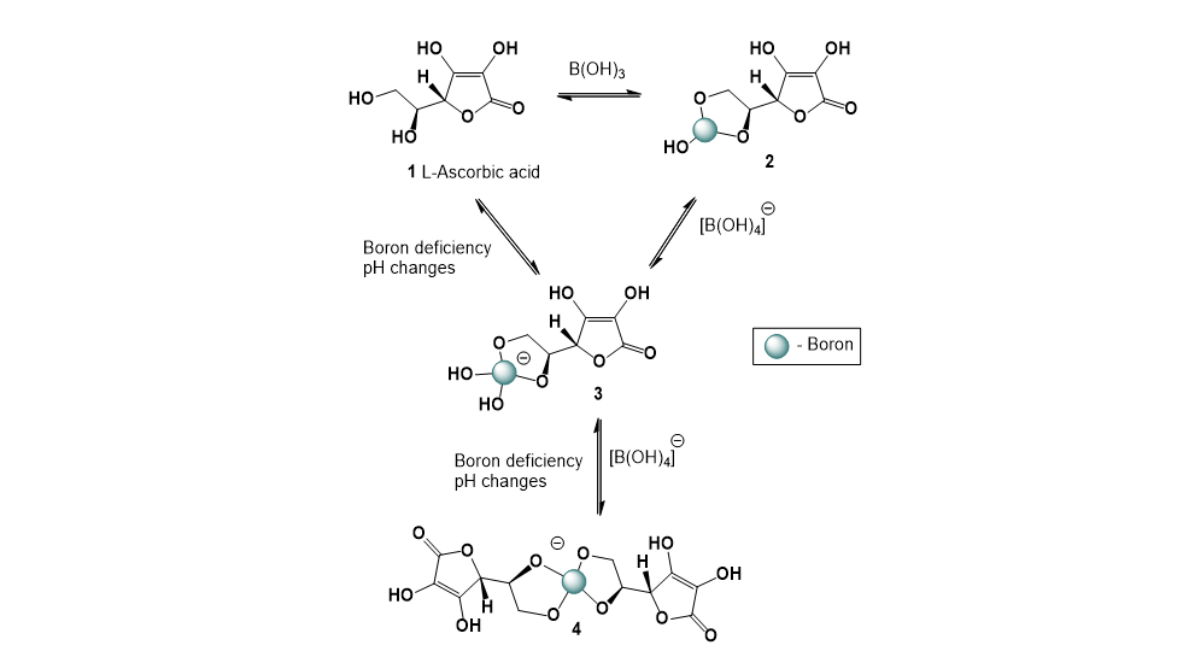
Figure 1: Basic scheme for the formation of boron complexes with L-ascorbic acid. The complex is formed through coordination of the 2,3-cis-enediol hydroxyl groups of L-ascorbic acid to the electron-deficient boron center, resulting in a five-membered cyclic borate ester. This reversible, pH-dependent interaction converts boron from trigonal planar to tetrahedral geometry and may influence the stability, redox behavior, and bioavailability of ascorbic acid in topical formulations.
Industrial production of L-ascorbic acid is dominated by fermentation-based technologies derived from the classical Reichstein process and its modern biotechnological modifications. The traditional Reichstein process combines chemical steps with microbial oxidation: D-glucose is hydrogenated to D-sorbitol, which is then selectively oxidized by Gluconobacter oxydans (formerly Acetobacter suboxydans) to L-sorbose. Subsequent chemical transformations convert L-sorbose into 2-keto-L-gulonic acid (2-KLG), which is finally lactonized to yield L-ascorbic acid [70-72]. Contemporary manufacturing increasingly relies on two-step or one-step fermentation systems using genetically optimized microbial strains, including Ketogulonicigenium vulgare in co-culture with Bacillus species, enabling efficient bioconversion of sorbose to 2-KLG with reduced chemical processing. Advances in metabolic engineering have further improved yields by modifying microbial pathways for direct glucose-to-2-KLG conversion, lowering production costs and environmental impact. Today, large-scale production is concentrated in industrial biotechnology facilities, particularly in China and Europe, where microbial fermentation accounts for the majority of the global vitamin C supply. Thus, L-ascorbic acid is obtained either through natural biosynthesis in plants and most animals or via sophisticated fermentation technologies that integrate microbial oxidation, enzymatic specificity, and controlled chemical transformation to meet pharmaceutical, nutritional, and cosmetic demands [72-75].
Other Active Hydroxy Acids and Their Boron Complexes
The reaction of boric acid (B(OH)₃) with glycolic acid (5, HO-CH₂-COOH) is primarily a coordination-esterification process driven by the ability of boron to act as a Lewis acid and of glycolic acid to function as an oxygen-donor ligand. Glycolic acid is the simplest α-hydroxy acid (AHA), containing both a hydroxyl group and a carboxylic acid group on adjacent carbon atoms. This structural arrangement makes it capable of chelating boron either through the α-hydroxy and carboxyl oxygen atoms or, under certain conditions, through diol-like interactions when partially deprotonated [49,76,77].
In aqueous solution, boric acid exists predominantly as trigonal planar B(OH)₃ but behaves as a Lewis acid by accepting hydroxide ions to form tetrahydroxyborate, [B(OH)₄]⁻. When glycolic acid is added, especially at mildly acidic to neutral pH, coordination occurs via donation of lone pairs from the oxygen atoms of glycolate to the electron-deficient boron center. Upon partial deprotonation of glycolic acid to the glycolate anion (HO-CH₂-COO⁻), chelation becomes more favorable. The α-hydroxy oxygen and the carboxylate oxygen can coordinate simultaneously, forming a five-membered cyclic boron chelate (6). In this process, one or more hydroxyl groups on boron are displaced, and boron typically adopts a tetrahedral (sp³) geometry. A simplified equilibrium representation can be written as:
B(OH)₃ + HO-CH₂-COO⁻ ⇌ [B(OH)₂(OCH₂COO)]⁻ + H₂O
Under more dehydrating or concentrated conditions, condensation reactions may occur with elimination of water, leading to more stable borate esters. Depending on stoichiometry, mono-(6) or bis(glycolato)borate complexes (7, see Figure 2) may form. In such species, glycolate can act either as a monodentate ligand (through the carboxylate only) or more commonly as a bidentate ligand forming a chelate ring with boron. The stability of these complexes increases with increasing pH, since deprotonation enhances the nucleophilicity of the coordinating oxygen atoms and favors formation of negatively charged borate species [49,76].
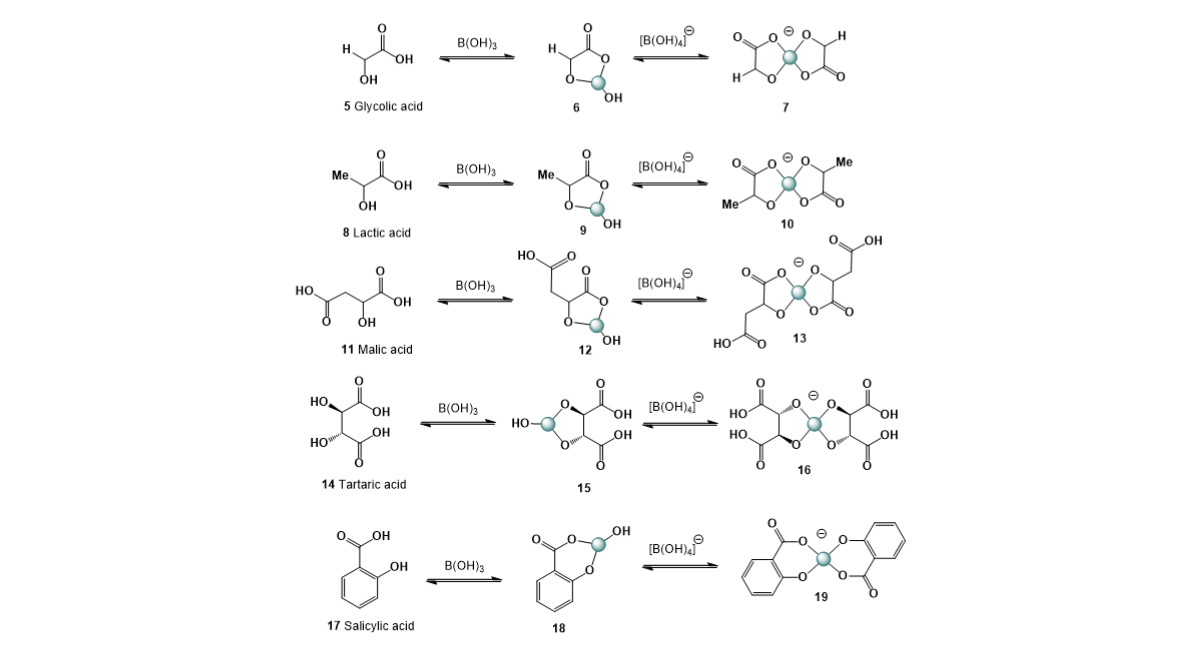
Figure 2: Schematic diagram of the formation of cosmetically active hydroxy acids and their boron complexes: glycolic acid, lactic acid, malic acid, tartaric acid, and salicylic acid. The scheme illustrates the coordination of hydroxyl and/or carboxylate groups of these hydroxy acids to the boron center, leading to the formation of cyclic borate or boronate complexes with tetrahedral geometry. These reversible, pH-dependent interactions may modulate effective acidity, enhance formulation stability, and enable controlled release of the active acid in topical cosmetic applications.
Thermodynamically, chelation is favored because formation of a five-membered ring provides entropic and enthalpic stabilization. However, the boron-glycolate bond remains reversible and pH-dependent, which is characteristic of borate esters. At lower pH, protonation weakens coordination and shifts the equilibrium toward free boric acid and glycolic acid.
From a practical standpoint, boric acid-glycolic acid interactions are relevant in solution chemistry, buffering systems, and potentially in cosmetic formulations where both components may coexist. Complex formation can slightly modify acidity, solubility, and reactivity of glycolic acid. Compared with strong cis-vicinal diols (such as in carbohydrates), glycolic acid forms moderately stable boron complexes, since it provides one hydroxyl and one carboxylate donor rather than two equivalent hydroxyl donors. Nonetheless, the reaction illustrates the broader coordination versatility of boron toward α-hydroxy carboxylic acids and its tendency to form cyclic, tetrahedral boron chelates with adjacent oxygen-containing functional groups [49,76,77].
Lactic acid (8, 2-hydroxypropionic acid) reacts with boric acid (B(OH)₃) or the borate anion (B(OH)₄⁻) through coordination involving its α-hydroxy and carboxyl functional groups, although its complex-forming ability is weaker than that of true vicinal (1,2-diol) systems. Structurally, lactic acid contains a single hydroxyl group at C-2 adjacent to a carboxylic acid group at C-1, enabling it to act as a bidentate ligand under suitable conditions. In aqueous solution, boric acid behaves as a Lewis acid and can accept electron pairs from oxygen donors. Upon partial deprotonation of lactic acid to the lactate anion (CH₃-CHOH-COO⁻), particularly at neutral to mildly alkaline pH, coordination becomes more favorable [78-80].
The hydroxyl oxygen and one of the carboxylate oxygens can simultaneously bind to the boron center, forming a five-membered cyclic borate chelate. During this process, boron transitions from trigonal planar (sp²) geometry in free boric acid to tetrahedral (sp³) geometry in the resulting borate complexes (9 and 10). The equilibrium may be represented as a reversible condensation reaction accompanied by partial displacement of boron hydroxyl groups and, in some cases, water elimination. Compared with cis-vicinal diols in sugars or polyols, lactic acid forms moderately stable boron complexes because it provides only one hydroxyl donor and one carboxylate donor rather than two hydroxyl groups. The stability of the boron-lactate complex increases with pH, where the lactate form predominates and nucleophilicity of the oxygen atoms is enhanced. Overall, lactic acid can coordinate to boron through α-hydroxy-carboxylate chelation, forming reversible, pH-dependent tetrahedral boron complexes that illustrate the broader affinity of boron for adjacent oxygen-containing functional groups beyond classical diol systems [78-81].
Malic acid (11, 2-hydroxybutanedioic acid) reacts with boric acid (B(OH)₃) or the borate anion (B(OH)₄⁻) through coordination involving its α-hydroxy-carboxylate system, forming chelated boron complexes under suitable pH conditions. Structurally, malic acid contains one hydroxyl group at C-2 adjacent to a carboxylic acid group at C-1, as well as a second carboxyl group at C-4. Although it does not possess a true 1,2-diol, the α-hydroxy and neighboring carboxylate oxygen atoms can act cooperatively as a bidentate ligand. In aqueous solution, particularly at neutral to mildly alkaline pH where malic acid is partially deprotonated to malate, the nucleophilicity of the oxygen atoms increases, facilitating coordination to the electron-deficient boron center [59,82-84]. The hydroxyl oxygen and one carboxylate oxygen bind simultaneously to boron, forming a five-membered cyclic borate chelate and converting boron from trigonal planar (sp²) geometry to tetrahedral (sp³) geometry. The equilibrium process involves substitution of one or more boron hydroxyl groups and may be accompanied by partial dehydration. Depending on pH and stoichiometry, mono-(12) or bis(malato)borate (13) complexes can form, and in some cases the second carboxylate group may contribute to stabilization through electrostatic or secondary coordination effects. Compared with cis-vicinal diols such as those found in sugars, malic acid forms moderately stable boron complexes, as it provides one hydroxyl and one carboxylate donor rather than two hydroxyl donors. The resulting boron-malate complexes are reversible and strongly pH-dependent, illustrating the broader coordination capacity of boron toward α-hydroxy dicarboxylic acids and their importance in solution chemistry and potential formulation systems [82-84].
The reaction of boric acid [B(OH)₃] with tartaric acid (14, HOOC-CHOH-CHOH-COOH) is a classical example of strong complex formation between boron and a cis-vicinal diol-containing dicarboxylic acid. Tartaric acid contains two adjacent hydroxyl groups at C-2 and C-3, in addition to two carboxylic acid groups. The presence of the 2,3-cis-diol system makes tartaric acid a particularly effective chelating ligand for boron, and its interaction with boric acid is significantly stronger than that observed with simple monohydroxy acids [62,76,85,86].
Boric acid is a Lewis acid rather than a classical proton donor. In aqueous solution, it accepts hydroxide ions to form tetrahydroxyborate, B(OH)₄⁻. When tartaric acid is added, complexation occurs through coordination of the two adjacent hydroxyl groups to the electron-deficient boron atom. The reaction involves donation of lone pairs from the oxygen atoms of the diol to boron, followed by condensation with elimination of water, producing a five-membered cyclic borate ester. In this complex, boron changes from trigonal planar (sp²) geometry in free boric acid to tetrahedral (sp³) geometry in the chelated form.
A simplified equilibrium representation is:
(OH)₃ + tartaric acid ⇌ cyclic borotartaric complex + H₂O
More specifically, under mildly acidic to neutral conditions, one of the most common species formed is a monoborotartaric acid complex (15), in which boron is bound to the 2,3-diol portion of the molecule. At higher pH, when tartaric acid is partially or fully deprotonated to tartrate (C₄H₄O₆²⁻), coordination becomes even stronger due to increased nucleophilicity of the oxygen atoms. In alkaline solution, tetrahedral borate species react readily with tartrate to form stable borotartrate anions (16), often written as [B(tartrate)(OH)₂]⁻ or related species depending on stoichiometry [76,85,86].
Importantly, tartaric acid markedly increases the apparent acidity of boric acid. This occurs because complex formation stabilizes the tetrahedral borate species, effectively shifting the equilibrium toward proton release. For this reason, mixtures of boric acid and tartaric acid (or other cis-diols) behave as stronger acids than boric acid alone. This phenomenon is well known in analytical chemistry and has historically been exploited in titrimetric determination of boron.
Under conditions of dehydration or higher concentrations, more condensed structures may form, including species in which one boron atom bridges between diol oxygens, or, in some cases, polymeric borate-tartrate networks. However, the predominant structure in aqueous solution is the five-membered chelate involving the vicinal diol. The carboxyl groups of tartaric acid may remain protonated or ionized depending on pH, and while they contribute to overall stability through electronic effects and possible secondary coordination, the primary binding site is the 2,3-cis-diol moiety [62,76].
The boric acid-tartaric acid reaction illustrates the strong affinity of boron for cis-vicinal diols and demonstrates how polyhydroxy carboxylic acids can stabilize tetrahedral boron complexes. Compared with simpler α-hydroxy acids such as glycolic acid, tartaric acid forms significantly more stable boron complexes due to the presence of a true 1,2-diol system. This reaction has both theoretical importance in coordination chemistry and practical relevance in analytical chemistry, buffering systems, and studies of boron-polyol interactions [62,76,85,86].
The biological and dermatological relevance of boron complexes of salicylic acid (SA) extends beyond simple coordination chemistry and into plant physiology, microbiology, and anti-biofilm strategy. Salicylic acid (17, 2-hydroxybenzoic acid) readily forms chelated complexes with boric acid (B(OH)₃) or borate (B(OH)₄⁻) through its ortho-hydroxy-carboxylate system, yielding tetrahedral boron-salicylate species (18 and 19). In plant systems, research indicates that SA can form boron complexes with water-soluble ligands such as sugars, glycerol, and organic acids. These complexes are believed to facilitate systemic transport of SA through xylem and phloem saps, highlighting a natural biological role for boron-mediated modulation of SA mobility and activity. This dynamic complexation may regulate bioavailability and distribution rather than simply serving as a structural interaction [87-92].
From a microbiological perspective, salicylic acid itself exhibits antibacterial properties, particularly in dermatological contexts such as acne management. However, its boron complexes appear to display additional biological effects, notably quorum sensing inhibition and antibiofilm activity. Quorum sensing is a bacterial communication system that regulates virulence factor production and biofilm formation. By interfering with these signaling pathways rather than directly killing bacteria, boron-salicylate complexes offer a strategy to suppress pathogenic behavior without exerting strong selective pressure for antibiotic resistance.
In silico investigations using the self-consistent extreme classifier (SCEC) model have suggested that combinations of salicylic acid and boric acid derivatives may enhance quorum sensing modulation. Computational findings indicate that certain boron-SA complexes exhibit dual activity, showing both inhibitory and activating effects depending on molecular structure and concentration [87]. This observation aligns with prior experimental evidence demonstrating that salicylic acid can exert concentration-dependent and context-dependent modulation of biofilm formation. Importantly, boron complexation appears to amplify the biological activities not only of SA itself but also of its conjugates with organic acids such as malic or citric acid, as well as sugar derivatives. These boron-mediated systems can interfere with bacterial signaling cascades and suppress biofilm development, thereby reducing bacterial persistence and virulence.
In cosmetology and dermatology, this property is particularly attractive for conditions involving biofilm-associated pathogens, including acne vulgaris (Cutibacterium acnes), seborrheic dermatitis, and certain chronic wound or scalp conditions. By targeting quorum sensing pathways rather than bactericidal mechanisms alone, boron-salicylic acid complexes could function as anti-virulence agents, minimizing disruption of the skin microbiome while attenuating pathogenic activity. This approach may reduce the development of antimicrobial resistance while enhancing the overall antibacterial efficacy of salicylic acid [87-92].
Boron complexes of salicylic acid represent a promising multifunctional system: they may improve transport and bioavailability, enhance antibiofilm and quorum sensing inhibition properties, modulate microbial behavior without strong selective pressure for resistance, and potentially expand the therapeutic scope of SA in dermatology. While further experimental and clinical validation is required, these findings suggest that boron-salicylate chemistry could open new avenues in anti-biofilm dermatological formulations and microbiome-conscious cosmetic strategies [87]
Sugar Acids and Their Boron Complexes
Sugar acids are a broad class of carbohydrate derivatives formed by the oxidation of one or more functional groups of monosaccharides, resulting in molecules that retain the polyhydroxy backbone of sugars but contain one or more carboxyl groups. Depending on the position and extent of oxidation, sugar acids are generally classified into three principal categories: aldonic acids (20, Figure 3), aldaric acids (23), and D-gluconic acids (26). Aldonic acids arise from oxidation of the aldehyde group at C-1 of an aldose to a carboxylic acid, while the primary alcohol group at C-6 remains unchanged; examples include gluconic acid derived from glucose and galactonic acid from galactose. Uronic acids result from oxidation of the terminal primary alcohol group (usually C-6) to a carboxyl group while preserving the aldehyde or its cyclic hemiacetal form; important representatives include glucuronic acid, galacturonic acid, and iduronic acid, which are key components of glycosaminoglycans and plant pectins. Aldaric acids are produced when both the aldehyde (C-1) and the primary alcohol (C-6) groups are oxidized to carboxyl functions, yielding dicarboxylic acids such as glucaric acid and galactaric (mucic) acid. In addition to these classical groups, more complex sugar acids such as aldobionic acids (e.g., lactobionic acid) consist of a sugar linked to a sugar acid via a glycosidic bond, combining strong humectant properties with metal-chelating and antioxidant activity [93-95].
Chemically, sugar acids are highly hydrophilic due to their multiple hydroxyl groups and one or more carboxylate moieties, which confer strong hydrogen-bonding capacity, metal-ion chelation, and buffering behavior in aqueous systems. Their acidity is typically mild to moderate, depending on the number and position of carboxyl groups, and they often exist as lactones under certain pH conditions, particularly in the case of aldonic acids such as gluconic acid forming gluconolactone. Biologically, sugar acids play crucial structural and metabolic roles: glucuronic acid participates in hepatic detoxification through glucuronidation reactions; galacturonic acid forms the backbone of pectic polysaccharides in plant cell walls; and iduronic and glucuronic acids contribute to the structural diversity and biological activity of heparin, chondroitin sulfate, and other glycosaminoglycans. In cosmetic and pharmaceutical applications, sugar acids are valued for their gentle exfoliating properties, humectant capacity, antioxidant activity, and compatibility with sensitive skin. Polyhydroxy and aldobionic acids, in particular, have gained attention as mild alternatives to traditional -hydroxy acids, offering keratinization modulation with reduced irritation while providing additional barrier-support and free-radical-scavenging effects. Thus, sugar acids represent a versatile family of multifunctional carbohydrate derivatives whose physicochemical properties bridge carbohydrate chemistry, biological metabolism, and modern dermatological science [93-96].
Gluconic acid (20, aldonic acid) the C-1 oxidation product of glucose, contains a linear hexonic acid backbone bearing multiple hydroxyl groups whose relative stereochemistry strongly influences its coordination behavior toward boron. In its predominant conformations in aqueous solution, the hydroxyl groups at C-3 and C-4 adopt a cis (erythro-type) relationship, allowing them to function as an efficient vicinal diol chelation site. This geometric arrangement enables simultaneous coordination of both oxygen atoms to an electron-deficient boron center, such as boric acid (B(OH)₃), borate (B(OH)₄⁻), or boronic acids (R-B(OH)₂). Upon interaction, the two adjacent hydroxyl groups donate lone pairs to boron, resulting in formation of a five-membered cyclic borate ester in which boron transitions from trigonal planar (sp²) to tetrahedral (sp³) geometry. The reaction is typically favored at neutral to mildly alkaline pH, where partial deprotonation of the hydroxyl groups increases their nucleophilicity and stabilizes the resulting borate complex. The equilibrium can be viewed as a reversible condensation process accompanied by water elimination, and the resulting gluconate-borate complex often exists as an anionic tetrahedral species in solution [97-100].
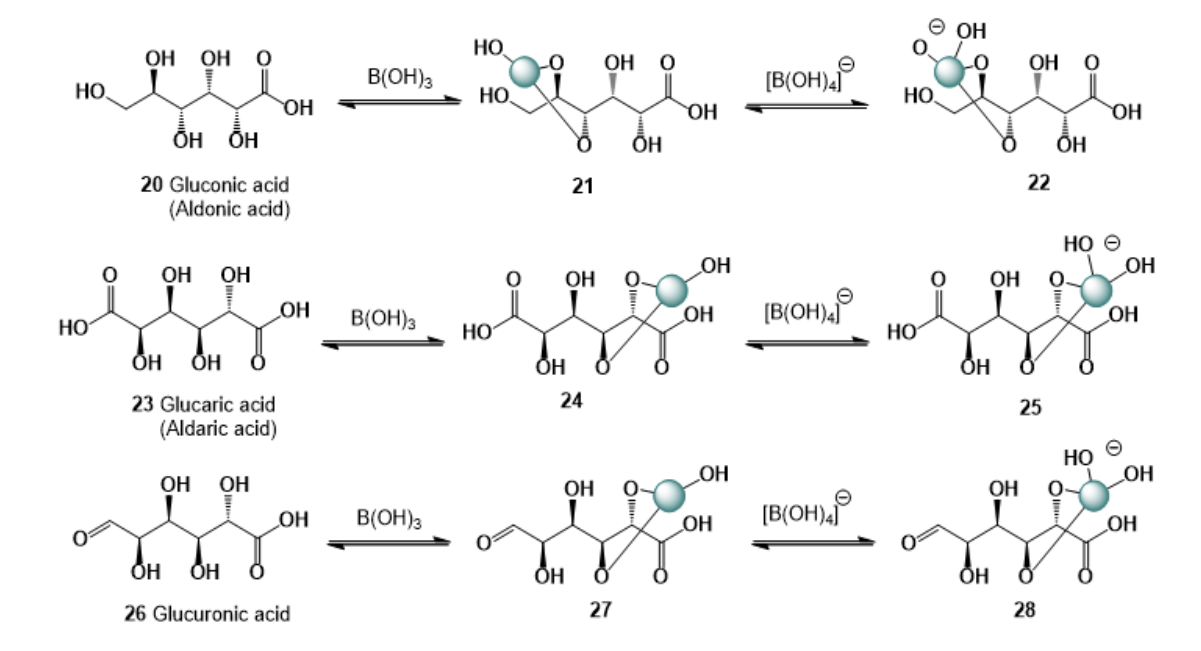
Figure 3: Schematic diagram of the formation of cosmetically active boron complexes of sugar acids. The diagram depicts the coordination of cis-vicinal diol groups present in sugar acids to boric acid or borate species, resulting in the formation of five-membered cyclic borate esters with tetrahedral boron geometry. These reversible complexes may enhance hydration, antioxidant stabilization, and microbiome-modulating potential, while enabling controlled release and improved tolerability in cosmetic and dermatological formulations.
Although gluconic acid possesses additional hydroxyl groups capable of interaction, the 3,4-cis-diol site provides an energetically favorable chelate ring with minimal strain and optimal O-B-O bond angles, making it the preferred binding locus. This strong and selective complexation explains the frequent use of gluconate ligands in boron chemistry and highlights the importance of cis-vicinal diol geometry in stabilizing boron-polyol complexes [97-98].
The potential application of aldonic acid-boron complexes (21 and 22) in cosmetology and dermatology arises from the strong affinity of boron for the cis-vicinal diol systems present in aldonic acids. Aldonic acids (e.g., gluconic acid, galactonic acid, and mannonic acid) are formed by oxidation of the aldehyde group of aldoses to a carboxylic acid while retaining multiple hydroxyl groups along the carbon chain. Many aldonic acids contain 1,2-or 2,3-cis-diol arrangements that readily coordinate boron, forming five-membered cyclic borate esters in which boron adopts a tetrahedral (sp³) geometry. These complexes are reversible and pH-dependent, establishing an equilibrium between the free aldonic acid and its boron-bound form [97-99].
From a cosmetic and dermatological perspective, several functional advantages can be identified: (i) Certain aldonic acids, particularly gluconic acid and its lactone (gluconolactone), are classified as polyhydroxy acids (PHAs). They provide gentle exfoliation and promote epidermal renewal with lower irritation potential compared to traditional alpha-hydroxy acids (AHAs). Boron complexation may further regulate free acid availability, enabling controlled release and reducing irritation; (ii) Aldonic acids are highly hydrophilic and act as effective humectants. In their complexed form, reversible boron-diol interactions may promote weak supramolecular structuring at the skin surface, improving film formation and reducing transepidermal water loss (TEWL); (iii) Aldonic acids are capable of chelating trace metal ions that catalyze oxidative processes. Boron complexation may stabilize these systems and enhance the oxidative stability of both the active ingredient and the overall formulation; (iv) Boron-containing complexes of polyhydroxy compounds have been reported to influence bacterial quorum sensing and biofilm formation. Accordingly, aldonic acid-boron systems may contribute to microbiome-friendly antimicrobial strategies, particularly in formulations for acne-prone or sensitive skin; (v) Boron-polyol interactions can influence viscosity and network formation in aqueous systems, potentially improving texture, substantivity, and active delivery without the need for permanent cross-linked polymers; and (vi) Complexation may reduce the availability of free borate, thereby potentially improving safety and tolerability compared with uncomplexed boric acid systems.
However, practical application requires careful consideration of regulatory restrictions on boron compounds in cosmetic products, as well as thorough safety assessment to ensure minimal systemic exposure. Additionally, while the coordination chemistry is well established, robust clinical data demonstrating superior dermatological benefits compared with conventional PHA systems remain limited [100-103].
Aldonic acid-boron complexes (21 and 22) represent a promising multifunctional platform in cosmetology and dermatology, offering potential advantages in controlled exfoliation, hydration enhancement, antioxidant support, microbiome modulation, and formulation stability. Their future utility will depend on balanced optimization of efficacy, safety, and regulatory compliance [98-103].
Glucaric acid (23, aldaric acid), the fully oxidized derivative of glucose in which both the C-1 aldehyde and the C-6 primary alcohol are converted to carboxylic acid groups, retains a polyhydroxylated backbone that strongly influences its coordination chemistry. In its predominant conformations in aqueous solution, the hydroxyl groups at C-2 and C-3 are arranged in a cis-(erythro-type) relationship, creating an ideal vicinal diol site for boron binding. This 2,3-cis-diol system readily chelates boron species such as boric acid (B(OH)₃), borate (B(OH)₄⁻), or boronic acids (R-B(OH)₂). Upon interaction, the adjacent hydroxyl oxygens donate electron density to the electron-deficient boron center, forming a five-membered cyclic borate ester in which boron adopts a tetrahedral (sp³) coordination geometry. The process is favored at neutral to mildly alkaline pH, where partial deprotonation enhances the nucleophilicity of the diol oxygens and stabilizes the resulting borate complex [105-108]. Although glucaric acid contains additional hydroxyl groups and two terminal carboxylate functions that can influence electronic distribution and solubility, the 2,3-cis-diol provides the most energetically favorable chelation site due to minimal ring strain and optimal O-B-O bond alignment. In alkaline solution, glucarate anions can further stabilize boron complexes through electrostatic interactions and, in some cases, secondary coordination involving carboxylate groups. Overall, the presence of the 2,3-cis-vicinal diol in glucaric acid enables efficient and reversible boron complex formation, exemplifying the strong affinity of boron for properly oriented polyhydroxy ligands and highlighting the importance of stereochemical arrangement in determining chelation strength [105,106].
The potential application of aldaric acid-boron complexes (24 and 25) in cosmetology and dermatology is rooted in the unique structural features of aldaric acids and their strong affinity for boron coordination. Aldaric acids (e.g., glucaric acid, galactaric acid/mucic acid) are formed by oxidation of both the aldehyde (C-1) and primary alcohol (C-6) groups of aldoses to carboxylic acids. As a result, they are dicarboxylic polyhydroxy acids containing multiple hydroxyl groups along the carbon backbone, often including cis-vicinal diol systems (e.g., 2,3-or 3,4-positions) that readily chelate boron. In the presence of boric acid (B(OH)₃) or borate (B(OH)₄⁻), these diol sites form five-membered cyclic borate esters, converting boron from trigonal planar (sp²) to tetrahedral (sp³) geometry. The interaction is reversible and strongly pH-dependent [105,106,109].
From a dermatological and cosmetic perspective, several advantageous properties can be identified: (i) Aldaric acids are highly hydrophilic and generally exhibit lower skin penetration compared to smaller alpha-hydroxy acids (AHAs). When coordinated with boron, the effective acidity and concentration of free acid may be attenuated, enabling more controlled modulation of keratinization with reduced irritation potential; (ii) The presence of two terminal carboxyl groups together with multiple hydroxyl functionalities renders aldaric acids efficient chelators of transition metal ions that catalyze oxidative processes. Boron complexation may further stabilize these systems and enhance resistance to oxidative degradation in formulations exposed to light or oxygen; (iii) Their polyhydroxy nature contributes to strong water-binding capacity and humectant behavior. Reversible boron-diol interactions may promote the formation of weak supramolecular networks at the skin surface, improving substantivity and reducing transepidermal water loss (TEWL); (iv) Boron-polyol interactions have been associated with modulation of quorum sensing and inhibition of biofilm formation. Consequently, aldaric acid-boron complexes may support microbiome-friendly strategies for managing acne-prone or sensitive skin by influencing bacterial communication rather than exerting direct bactericidal effects; and (v) Complex formation may decrease the concentration of free borate, thereby potentially improving safety and minimizing irritation while preserving functional efficacy within the formulation.
Aldaric acid-boron complexes (24 and 25) represent a chemically robust and multifunctional system with potential benefits in gentle exfoliation, antioxidant stabilization, hydration enhancement, microbiome modulation, and formulation performance. Their successful use in cosmetology and dermatology would depend on careful optimization of concentration, delivery system, safety profile, and regulatory compliance, along with validation of clinical efficacy.
Glucuronic acid (26), the C-6 oxidized derivative of glucose, contains a carboxylic acid group at C-6 and multiple hydroxyl groups along its pyranose ring. Of particular importance for boron chemistry are the cis-oriented hydroxyl groups at C-2 and C-3, which form a vicinal diol system capable of efficient chelation. In aqueous solution, boric acid (B(OH)₃) behaves as a Lewis acid and can accept electron pairs from oxygen donors. When glucuronic acid is presentespecially at neutral to mildly alkaline pHthe 2,3-cis-diol moiety coordinates to the boron center through simultaneous donation of lone pairs from both hydroxyl oxygens. This interaction results in the formation of a five-membered cyclic borate ester involving an O-B-O bridge between C-2 and C-3. During complex formation, boron transitions from its trigonal planar (sp²) geometry in free boric acid to a tetrahedral (sp³) configuration in the chelated complex [109-113].
Under alkaline conditions, where borate (B(OH)₄⁻) predominates and glucuronic acid is partially deprotonated to glucuronate, complexation becomes more favorable. Deprotonation increases the nucleophilicity of the diol oxygen atoms and stabilizes the resulting borate-glucuronate complex, which typically exists as a negatively charged tetrahedral species in solution. The equilibrium can be described as a reversible condensation reaction accompanied by the elimination of water, with stability strongly dependent on pH and ionic strength. Although glucuronic acid also contains a carboxylate group at C-6 that can influence solubility and electronic distribution, the primary binding site for boron is the 2,3-cis-vicinal diol, because this arrangement allows formation of a low-strain five-membered chelate ring with optimal O-B-O bond angles. The resulting boron complex is reversible and dynamic, characteristic of borate-polyol interactions. Thus, glucuronic acid reacts readily with boric acid or borate anions through its 2,3-cis-diol system, forming stable cyclic borate esters that exemplify the strong affinity of boron for properly oriented vicinal diols in carbohydrate-derived acids [112-116].
The potential use of glucuronic acid-boron complexes (27 and 28) in cosmetology and dermatology is based on the strong affinity of boron for the 2,3-cis-vicinal diol system present in glucuronic acid, combined with the biological relevance of glucuronic acid in skin metabolism and detoxification pathways.
Glucuronic acid is a uronic acid derived from glucose in which the C-6 primary alcohol is oxidized to a carboxylic acid. In aqueous solution, especially in its pyranose form, the hydroxyl groups at positions 2 and 3 can adopt a cis configuration suitable for boron chelation. In the presence of boric acid (B(OH)₃) or borate (B(OH)₄⁻), these hydroxyl groups coordinate to the boron center, forming a five-membered cyclic borate ester. During this process, boron shifts from trigonal planar (sp²) to tetrahedral (sp³) geometry. The complexation is reversible and pH-dependent, establishing equilibrium between free glucuronic acid and the boron-bound species [113-116].
From a dermatological perspective, several functional attributes can be proposed: (i) Glucuronic acid is highly hydrophilic and structurally related to glycosaminoglycan components, including precursors of hyaluronic acid. It plays an important role in water retention and extracellular matrix hydration. In its boron-complexed form, reversible boron-diol coordination may facilitate the formation of weak supramolecular films at the skin surface, thereby enhancing hydration and reducing transepidermal water loss (TEWL); (ii) In human physiology, glucuronic acid is involved in glucuronidation pathways that support the detoxification of xenobiotics. Although topical application does not replicate systemic metabolic processes, its inherent biochemical compatibility with skin tissues may favor barrier-supportive formulations. Boron complexation may further influence molecular stability and local availability; (iii) The presence of multiple hydroxyl groups together with a carboxylate functionality enables glucuronic acid to chelate transition metal ions that promote oxidative reactions. Coordination with boron may enhance molecular stability and contribute to improved oxidative protection, particularly in formulations exposed to UV radiation; (iv) Boron-polyol systems have been associated with modulation of bacterial quorum sensing and inhibition of biofilm formation. Accordingly, glucuronic acid-boron complexes may support microbiome-conscious cosmetic approaches by influencing microbial communication rather than exerting strong bactericidal effects; and (v) Complex formation may reduce the concentration of free borate species within formulations, potentially improving tolerability and minimizing irritation while allowing gradual dissociation under physiological skin conditions.
Glucuronic acid-boron complexes (27 and 28) represent a chemically sound and biologically compatible system with potential applications in hydration enhancement, barrier support, oxidative stabilization, microbiome modulation, and controlled boron delivery. While promising from a mechanistic and formulation standpoint, their practical use in cosmetology and dermatology would require careful safety evaluation and validation of efficacy in clinical settings [114-119].
Boron Complexes of Sugar Acids: Aldonic, Aldaric, and Uronic Systems in Dermatological Applications
Sugar acids, including aldonic, aldaric, and uronic acids, represent a structurally related class of polyhydroxy carboxylic acids characterized by multiple cis-diol motifs and, in some cases, terminal or internal carboxylate groups. These features make them particularly well suited for coordination with boron through the formation of reversible boronate esters. Such interactions generate dynamic complexes in which boron adopts a tetrahedral geometry, establishing equilibria between free and bound forms that are strongly influenced by pH and local chemical conditions [97-99].
From a dermatological and cosmetic perspective, these boron-sugar acid systems exhibit several complementary functional properties. First, their high hydrophilicity and dense hydroxyl functionality contribute to water-binding capacity and humectant behavior, supporting skin hydration and extracellular matrix stability. In the presence of boron, reversible boron-diol coordination may promote the formation of weak supramolecular networks or surface films, enhancing substantivity and reducing transepidermal water loss (TEWL).
Second, the modulation of acidity through boron complexation represents an important functional advantage. Aldonic acids (e.g., gluconic acid and related polyhydroxy acids) and aldaric acids can act as mild exfoliating or keratinization-modulating agents. When complexed with boron, the effective concentration of free acid may be reduced, enabling controlled release and reduced irritation compared to conventional alpha-hydroxy acids (AHAs), while maintaining beneficial effects on epidermal renewal.
Third, the presence of multiple hydroxyl and carboxylate groups confers strong metal-chelating properties, allowing these acids to sequester transition metal ions that catalyze oxidative reactions. Boron coordination may further stabilize these systems and enhance resistance to oxidative degradation, particularly in formulations exposed to light, oxygen, or UV radiation [28,36,53-55].
Fourth, boron-polyol interactions have been associated with modulation of microbial behavior, including interference with quorum sensing and inhibition of biofilm formation. Accordingly, boron complexes of sugar acids may support microbiome-conscious cosmetic strategies by influencing bacterial communication pathways rather than exerting direct bactericidal effects, which is particularly relevant for sensitive or acne-prone skin.
Fifth, glucuronic acid, as a representative uronic acid, introduces an additional level of biological relevance due to its role in glycosaminoglycan structure and detoxification pathways. Although topical application does not replicate systemic glucuronidation, its structural compatibility with skin biochemistry may favor barrier-supportive and physiologically compatible formulations, with boron complexation potentially influencing stability and local availability.
Finally, complex formation generally reduces the concentration of free borate species, which may improve safety and tolerability while preserving functional activity. At the same time, the reversible nature of boron-diol coordination ensures that these systems remain dynamic, allowing gradual dissociation under physiological skin conditions [36,38, 55,85,86].
Taken together, boron complexes of aldonic, aldaric, and uronic acids can be viewed as adaptive supramolecular systems, combining hydration, controlled bioactivity, oxidative protection, and microbiome modulation within a single chemical framework. Their functionality arises not from permanent structural modification, but from reversible coordination chemistry, enabling responsive behavior at the skin interface.
Table 1 summarizes the currently available evidence on boron-containing systems relevant to dermatology/cosmetology, distinguishing studies that directly exploit boronate/borate interactions with vicinal diols or catechols from broader topical boron formulations in which the precise complexation state is not resolved.
|
Vicinal diol ligand / partner |
Boron species or complex |
Study type |
Model / system |
Dermatologic or cosmetic relevance |
Main finding |
Evidence level / limitation |
|
Poly(vinyl alcohol) (PVA) |
Boric acid-PVA boronic ester network |
In vitro / ex vivo materials study |
Dynamic adhesive film tested on rough, hairy mouse skin and other substrates |
Reversible wound-dressing adhesion; possible skin patch platform |
Rapid water-activated adhesion, strong yet reversible bonding, and tunable crosslink density for skin-contact adhesives. |
Preclinical only; not a therapeutic efficacy study and not a cosmetic trial. |
|
Catechol / chlorinated catechol |
Phenylboronic acid-catechol boronate complex |
In vitro |
Antibacterial pH-responsive hydrogel; human skin fibroblast cytocompatibility |
Antimicrobial dressings; skin-contact biomaterials |
Reversible catechol-boronate complexation modulated antibacterial activity and reduced cytotoxicity at higher pH; active against multiple bacteria including MRSA. |
No animal or clinical skin efficacy shown in this study. |
|
Catechol groups + EGCG (polyphenolic catechol) |
Boronic acid-catechol dynamic hydrogel |
In vitro + in vivo |
Injectable quaternized-chitosan hydrogel; full-thickness skin defect model |
Regenerative wound dressings; antioxidant/antibacterial skin biomaterial |
Hydrogel showed self-healing, antibacterial and antioxidant properties, good biocompatibility, and improved wound healing in a full-thickness skin-defect model. |
Animal evidence only; no human dermatology/cosmetic trial. |
|
Unspecified dermal-cell interface; boron salts |
Boron salts (non-complex-specific) |
In vitro |
Human keratinocyte migration assay |
Re-epithelialization / skin repair |
Boron salts accelerated keratinocyte wound closure/migration without increased proliferation. |
Supports cell migration, but not a defined vicinal-diol complex. |
|
Dermal extracellular-matrix components |
Boric acid (non-complex-specific) |
In vitro |
Human dermal fibroblasts |
Wound repair / matrix remodeling |
Boric acid altered extracellular-matrix turnover and TNF-α release in fibroblasts; related enzymatic effects on elastase and alkaline phosphatase were also reported. |
Mechanistic support, but not direct proof of a boron-diol complex in skin. |
|
Pluronic-containing hydrogel matrix |
Sodium pentaborate pentahydrate hydrogel |
In vitro + in vivo |
Dermal cells; rat full-thickness wound model |
Chronic wound management |
Increased wound contraction and collagen deposition; authors proposed usefulness for chronic wounds/dermatologic practice. |
Promising, but the specific boron-vicinal-diol complex is not chemically resolved in the biological data. |
|
Topical boric acid solution |
3% boric acid |
Clinical observational / retrospective case-control |
31 ICU patients with deep wounds; 12-patient retrospective comparison |
Severe wound care / dermatologic tissue repair |
3% boric acid was associated with faster return to standard care after granulation versus conventional antiseptics. |
Human evidence exists, but older, non-randomized, and toxicity/handling concerns were noted. |
|
Polyurethane sponge matrix |
Boric acid particle-impregnated NPWT sponge |
Clinical prospective randomized study |
100 patients with chronic wounds and tissue defects |
Chronic wound dressing |
Boric-acid-particle sponges combined with negative-pressure therapy improved chronic wound recovery compared with comparator treatment. |
Human evidence, but this is a device/formulation study, not a defined small-molecule boron-diol complex study. |
|
Boron-based gel (composition not fully disclosed in abstract) |
Topical boron gel |
Clinical phase III randomized, double-blind, placebo-controlled trial |
Breast-cancer patients receiving radiotherapy |
Radiation dermatitis prevention |
Significant preventive effect on several radiation-dermatitis categories was reported. |
Clinically relevant, but complex chemistry not specified and not clearly a vicinal-diol boron complex. |
|
Sodium pentaborate pentahydrate gel |
Topical sodium pentaborate pentahydrate 3% |
Clinical randomized, double-blind, placebo-controlled trial |
206 patients with grade 1-3 hemorrhoids |
Mucocutaneous wound healing / barrier support |
Reduced itching, pain, bleeding, and hemorrhoid grade versus placebo. |
Human evidence, but anorectal mucosa rather than cosmetic dermatology. |
|
Sodium pentaborate pentahydrate gel |
Topical sodium pentaborate pentahydrate 3% |
Clinical randomized, double-blind, placebo-controlled trial |
206 patients with grade 1-3 hemorrhoids |
Mucocutaneous wound healing / barrier support |
Reduced itching, pain, bleeding, and hemorrhoid grade versus placebo. |
Human evidence, but anorectal mucosa rather than cosmetic dermatology. |
|
Boron-based gel |
Topical boron gel |
Clinical retrospective controlled study |
450 primiparous women after episiotomy |
Perineal wound healing |
Reported improved episiotomy wound healing and reduced pain. |
Human evidence, but obstetric/perineal rather than core cosmetic dermatology. |
|
Local boric acid powder |
Boric acid powder |
Clinical case study |
Two patients with diabetic wounds |
Difficult wound management |
Local boric acid cleared necrosis and accelerated healing in reported cases. |
Case-level evidence only. |
Table 1: Vicinal diol compounds and their boron complexes relevant to cosmetology/dermatology
Polyols and Sugars and Their Boron Complexes
Polyols and sugars play a key role in boron binding due to the presence of cis-1,2-diol (vicinal diol) groups, which can form reversible cyclic boron esters with boric acid (B(OH)₃) or borate ions (B(OH)₄⁻). Boron binds most effectively to molecules containing adjacent hydroxyl groups in a suitable spatial orientationsuch as mannitol, sorbitol, ribose, and other sugars and sugar alcohols. In aqueous media at neutral and slightly alkaline pH, five-or six-membered cyclic boron-diol complexes form, reducing the concentration of "free" reactive boron. This is of great importance in biological systems: cell wall polysaccharides, exopolysaccharides, and intracellular polyols can serve as buffers or reservoirs for boron, reducing its cytotoxicity and regulating its bioavailability. Such complexes are dynamic and dependent on pH, ionic strength, and the presence of competing ligands, but it is thanks to sugars and polyols that many organisms are able to tolerate elevated boron concentrations while maintaining physiological equilibrium [22,23,34,55,120-126].
D-Mannitol (29), a hexitol (sugar alcohol) derived from mannose, contains six hydroxyl groups arranged along a flexible carbon chain, with particularly important cis-vicinal diol pairs at positions 2,3 and 3,4. These adjacent hydroxyl groups provide highly favorable binding sites for boron species such as boric acid (B(OH)₃) or borate (B(OH)₄⁻). In aqueous solution, boric acid behaves as a Lewis acid and forms cyclic borate esters with properly oriented diols. When D-mannitol is present, the oxygen atoms of the 2,3-cis-diol (30) or the 3,4-cis-diol (31) donate lone pairs to the electron-deficient boron center, producing a five-membered O-B-O chelate ring and converting boron from trigonal planar (sp²) to tetrahedral (sp³) geometry. Because mannitol possesses more than one suitable diol pair, complexation can occur at either the 2,3-or 3,4-position, giving rise to at least two positional isomeric borate complexes. Under alkaline conditions, where borate anion predominates and hydroxyl groups are more nucleophilic, complex formation is enhanced, and negatively charged borate-mannitol species are stabilized in solution [127-131]. In some cases, especially at higher boron concentrations, mannitol can even coordinate two boron centers or form bridged structures, further increasing apparent boric acid acidityan effect exploited in analytical chemistry for boron titration. The equilibria are reversible and strongly pH-dependent, but the presence of multiple cis-diol sites in D-mannitol makes it one of the most effective polyol ligands for boron, illustrating the strong preference of boron for flexible polyhydroxyl systems capable of forming low-strain five-membered chelate rings [129-131].
The potential use of D-mannitol-boron complexes in cosmetology and dermatology is based on the strong and reversible interaction between boron species (boric acid or borate) and the multiple cis-vicinal diol groups present in D-mannitol. D-Mannitol is a hexitol widely used in pharmaceutical and cosmetic formulations as a humectant, antioxidant stabilizer, bulking agent, and osmoprotectant. Because it contains several adjacent hydroxyl pairs (notably at positions 2,3 and 3,4), it forms stable cyclic borate esters, with boron adopting a tetrahedral configuration. These complexes are dynamic and pH-dependent, creating equilibrium between free mannitol and boron-bound forms [127-131].
From a cosmetic perspective, several functional advantages can be proposed: (i) Mannitol is well known for its ability to scavenge hydroxyl radicals and protect sensitive active ingredients, such as peptides and vitamins, from oxidative degradation. Complexation with boron may further enhance formulation stability by modulating redox processes and reducing metal-catalyzed oxidation; (ii) As a highly hydrophilic polyol, mannitol contributes to water retention within the stratum corneum. In its boron-complexed form, reversible boron-diol interactions may facilitate the formation of weak supramolecular networks, improving film formation and enhancing surface hydration; (iii) Free boric acid can cause irritation at elevated concentrations. When complexed with mannitol, boron is present in a bound state, which may decrease the availability of free borate while allowing gradual and reversible release, thereby improving tolerability in topical formulations; (iv) Boron-containing systems have been associated with mild antimicrobial effects, and boron-polyol complexes may influence bacterial quorum sensing and biofilm formation. In conditions such as acne or seborrheic dermatitis, these properties could complement other active ingredients; and (v) Boron-mannitol interactions can generate weak, reversible cross-links in aqueous systems, potentially enhancing gel structure, viscosity, and skin adherence without requiring permanent polymerization.
D-Mannitol-boron complexes (30 and 31) are chemically robust, reversible systems that may offer antioxidant support, enhanced hydration, controlled boron delivery, mild antimicrobial effects, and improved formulation performance. While promising from a coordination chemistry and formulation standpoint, their dermatological value depends on careful safety assessment and clinical validation [129-134].
L-Sorbitol (32, L-glucitol) is a hexitol containing six hydroxyl groups distributed along a flexible carbon chain, and its stereochemical arrangement provides favorable cis-vicinal diol pairs at positions 2,3 and 3,4. These adjacent hydroxyl groups act as efficient chelation sites for boron species such as boric acid (B(OH)₃) or the borate anion (B(OH)₄⁻). In aqueous solution, boric acid functions as a Lewis acid and accepts electron pairs from oxygen donors. When L-sorbitol is present, the oxygen atoms of a cis-diol pair coordinate simultaneously to the boron center, forming a five-membered cyclic borate ester characterized by an O-B-O bridge. During this chelation process, boron changes from trigonal planar (sp 2) geometry to a tetrahedral (sp 3) configuration.
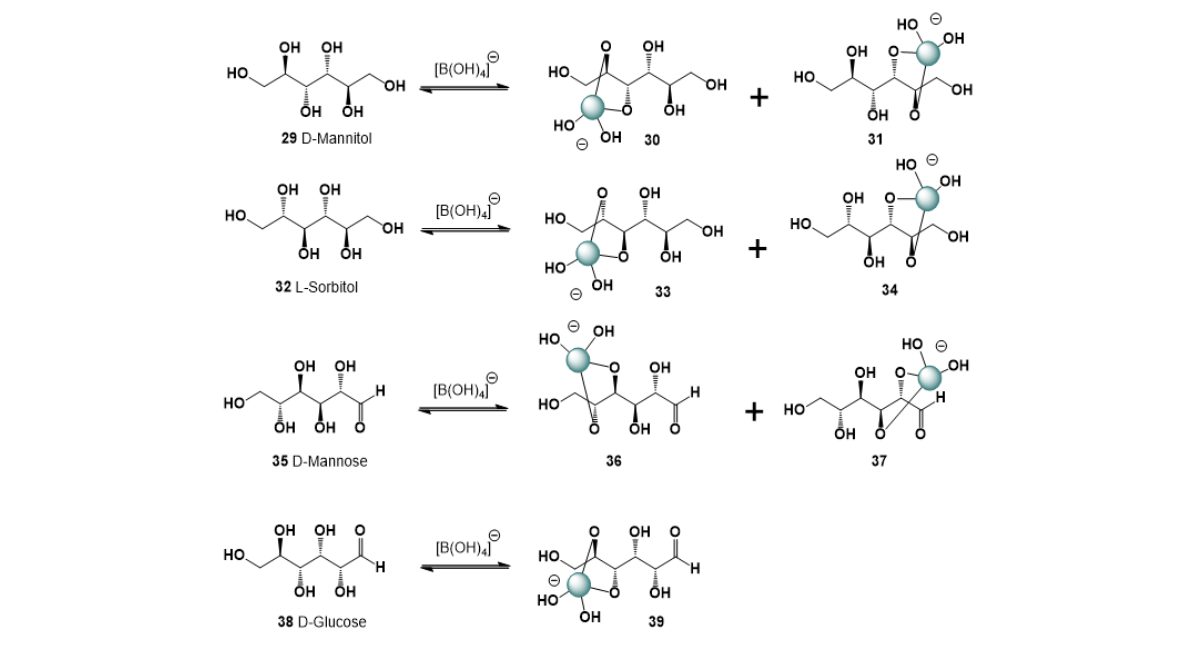
Figure 4: Schematic diagram of the formation of cosmetically active boron complexes using polyols and sugars. The scheme illustrates the coordination of boric acid or borate species with cis-vicinal diol groups present in polyols and monosaccharides, leading to the formation of reversible five-membered cyclic borate esters. Such dynamic boron-diol interactions can enhance hydration, influence rheological properties, and enable controlled boron availability in topical cosmetic and dermatological formulations.
Because L-sorbitol contains more than one suitable cis-diol arrangement, complexation can occur at either the 2,3-or the 3,4-position, producing at least two positional isomeric borate complexes (33 and 34). Under mildly alkaline conditions, where partial deprotonation increases the nucleophilicity of the hydroxyl groups and borate species predominate, complex formation is significantly enhanced and stabilized as negatively charged borate-sorbitol complexes. In some systems, especially at higher boron concentrations, additional coordination or bridging interactions may occur, further increasing stability and apparent acidity. The equilibria remain reversible and strongly pH-dependent, but the presence of multiple cis-diol sites makes L-sorbitol a highly effective ligand for boron, exemplifying the strong affinity of boron for flexible polyhydroxyl compounds capable of forming low-strain five-membered chelate rings [74,130-132,135,136].
The potential use of L-sorbitol-boron complexes in cosmetology and dermatology arises from the strong and reversible interaction between boron species (boric acid, B(OH)₃, or borate, B(OH)₄⁻) and the multiple cis-vicinal diol groups present in L-sorbitol. It is a polyol widely used in cosmetic and pharmaceutical formulations as a humectant, moisturizer, osmoprotectant, and stabilizing agent. Because it contains several adjacent hydroxyl pairs (notably at positions 2,3 and 3,4, it readily forms cyclic borate esters, in which boron adopts a tetrahedral (sp³) configuration. These complexes are reversible and pH-dependent, creating a dynamic equilibrium between free sorbitol and boron-bound species [130-133].
From a dermatological perspective, several potential benefits can be outlined: (i) Sorbitol is highly hydrophilic and plays an important role in maintaining water content within the stratum corneum. When complexed with boron, reversible boron-diol interactions may facilitate the formation of weak supramolecular networks at the skin surface, improving film formation, reducing transepidermal water loss (TEWL), and enhancing skin smoothness; (ii) Free boric acid may cause irritation at higher concentrations. Coordination with sorbitol can reduce the level of freely diffusible boron while enabling gradual and reversible release at physiological skin pH, thereby improving tolerability in topical formulations; (iii) Polyols such as sorbitol are known to stabilize sensitive active ingredients by maintaining hydration shells and mitigating oxidative stress within formulations. Boron-sorbitol complexes may further enhance stability by modulating redox processes and influencing metal ion-mediated oxidation; (iv) Boron-containing systems exhibit mild antimicrobial properties, and in combination with sorbitolwhich affects osmotic balancethese complexes may contribute to the inhibition of microbial growth, quorum sensing, or biofilm formation, offering potential benefits for acne-prone or compromised skin; and (v) Reversible boron-polyol interactions can subtly influence viscosity and gel structure in aqueous systems, improving substantivity, spreadability, and overall sensory performance without the need for permanent polymeric networks.
L-Sorbitol-boron complexes (33 and 34) represent a chemically stable, reversible, and multifunctional system with potential benefits in hydration enhancement, barrier support, controlled boron delivery, mild antimicrobial activity, and formulation stabilization. Their practical use in cosmetology and dermatology is promising but depends on careful safety assessment and clinical validation [130-132,135].
D-Mannose (35), an aldohexose and C-2 epimer of glucose, readily reacts with boric acid (B(OH)₃) or the borate anion (B(OH)₄⁻) through its cis-vicinal hydroxyl groups at positions 2,3 and 3,4, which provide favorable chelation sites for boron coordination. In aqueous solution, D-mannose predominantly adopts cyclic pyranose forms (α-and β-anomers), and within these ring conformations the stereochemical arrangement of the hydroxyl groups at C-2 and C-3, as well as at C-3 and C-4, allows formation of cis-oriented diol systems capable of binding boron. Upon interaction, the two adjacent hydroxyl oxygens donate lone pairs to the electron-deficient boron center, forming a five-membered cyclic borate ester characterized by an O-B-O bridge. This chelation converts boron from trigonal planar (sp²) geometry to tetrahedral (sp³) geometry. Because D-mannose contains more than one suitable cis-diol pair, complexation can occur at either the 2,3-or 3,4-position, resulting in at least two positional isomeric borate complexes (36 and 37), and additional variation may arise from the α-or β-anomeric configuration. Under mildly alkaline conditions, where borate species predominate and hydroxyl groups become more nucleophilic due to partial deprotonation, complex formation is enhanced and stabilized as negatively charged borate-mannose complexes. The equilibrium is reversible and strongly pH-dependent, but the presence of multiple cis-vicinal diol systems makes D-mannose an efficient ligand for boron, illustrating the strong stereochemical dependence of boron-carbohydrate complex formation and the preference for low-strain five-membered chelate rings [137-141].
The potential use of D-mannose-boron complexes in cosmetology and dermatology is based on the strong, reversible interaction between boron species (boric acid, B(OH)₃, or borate, B(OH)₄⁻) and the cis-vicinal diol groups present in D-mannose. D-Mannose (35) is a naturally occurring aldohexose structurally related to glucose and plays roles in glycoprotein biosynthesis and cell recognition processes. In aqueous systems, its hydroxyl groupsparticularly the 2,3-and 3,4-cis configurations in the pyranose formcan chelate boron to form five-membered cyclic borate esters (36 and 37), with boron adopting tetrahedral (sp³) geometry. These complexes are dynamic and pH-dependent, establishing equilibrium between free mannose and boron-bound forms [142-145].
From a dermatological standpoint, several functional prospects may be considered: (i) As a highly hydrophilic sugar, D-mannose can contribute to moisture retention and surface hydration. In boron-complexed form, reversible boron-diol interactions may create weak supramolecular networks that enhance film formation on the skin, potentially reducing transepidermal water loss (TEWL) and improving barrier function; (ii) D-Mannose is known to interfere with bacterial adhesion mechanisms in certain biological systems by binding to lectin-like adhesins. When combined with boron, additional quorum-sensing modulation or antibiofilm activity may occur, as boron-polyol systems have been associated with signaling interference in microorganisms. This suggests possible applications in acne-prone or microbiome-sensitive skin care formulations; (iii) Complexation with mannose may reduce the level of free boron species in a formulation, potentially lowering irritation risk while allowing gradual, reversible release. This controlled delivery mechanism could improve tolerability in topical applications; (iv) Sugars can stabilize sensitive cosmetic ingredients by influencing hydration layers and reducing oxidative degradation. Boron-mannose complexes may enhance such stabilizing effects through chelation and modulation of redox-active trace metals; (v) Boron-diol chemistry can contribute to weak cross-linking interactions in aqueous systems, potentially improving viscosity, texture, and substantivity without permanent polymer networks.
D-Mannose-boron complexes (36 and 37) represent a promising multifunctional system with potential roles in hydration enhancement, barrier support, microbiome modulation, controlled boron delivery, and formulation stabilization. Their future application in cosmetology and dermatology will depend on rigorous safety evaluation and validation of biological efficacy [138-145].
D-Glucose (38) reacts with boric acid (B(OH)₃) or borate (B(OH)₄⁻) through its cis-vicinal hydroxyl groups at C-3 and C-4, which provide a favorable chelation site for boron complex formation. In aqueous solution, D-glucose exists predominantly in cyclic pyranose forms (α-and β-anomers), and within these conformations the relative stereochemistry at positions 3 and 4 permits formation of a cis-diol arrangement capable of coordinating to boron. When boric acid is present, the electron-deficient boron atom accepts lone pairs from the two adjacent hydroxyl oxygens, leading to formation of a five-membered cyclic borate ester involving an O-B-O bridge between C-3 and C-4. During this process, boron undergoes a transition from trigonal planar (sp²) geometry to a tetrahedral (sp³) configuration. Under mildly alkaline conditions, where borate anion predominates and glucose hydroxyl groups exhibit increased nucleophilicity, the equilibrium shifts toward formation of a negatively charged borate-glucose complex (39) [128,131,146-150]. Because D-glucose can exist in both α-and β-pyranose forms, at least one structural isomer of the borate complex may form depending on the anomeric configuration and ring conformation. The interaction is reversible and strongly pH-dependent, but the 3,4-cis-diol system provides a thermodynamically favorable binding site due to low ring strain and optimal O-B-O bond angles. Thus, D-glucose readily forms stable cyclic borate esters via its 3,4-cis-vicinal diol, exemplifying the general affinity of boron for properly oriented carbohydrate hydroxyl groups [146-150].
Boron Complexes of Polyols: Mannitol, Sorbitol, and Related Systems in Cosmetic Applications
Polyols such as mannitol, sorbitol, and related sugar alcohols represent an important class of diol-rich compounds widely used in cosmetic and dermatological formulations. Their multiple hydroxyl groups, often arranged in favorable cis-vicinal configurations, enable efficient coordination with boron through the formation of reversible boronate esters. These interactions generate dynamic complexes in which boron adopts tetrahedral geometry, establishing equilibria between free and bound forms that depend on pH, concentration, and the presence of competing ligands [54,55,85,86,97-99].
From a functional standpoint, boron-polyol systems combine the intrinsic physicochemical properties of polyols with the adaptive behavior of reversible coordination chemistry. Polyols are highly hydrophilic and act as effective humectants, contributing to water retention within the stratum corneum. Upon complexation with boron, reversible boron-diol interactions may promote the formation of weak supramolecular networks at the skin surface, enhancing film formation, improving substantivity, and reducing transepidermal water loss (TEWL) [28,36,54].
Mannitol, in particular, is well recognized for its antioxidant properties, including the ability to scavenge hydroxyl radicals and protect sensitive active ingredients such as peptides and vitamins from oxidative degradation. Boron complexation may further enhance formulation stability by modulating redox processes and reducing the impact of metal-catalyzed oxidation. Similarly, sorbitol and related polyols may contribute to stabilization effects through their metal-chelating capacity and ability to influence the microenvironment of reactive species.
An additional advantage of boron-polyol systems lies in their potential to modulate the availability of free boric acid. At higher concentrations, uncomplexed boric acid may cause irritation; however, when coordinated with polyols, boron exists predominantly in a bound form. This reduces the concentration of free borate species while allowing gradual and reversible release under physiological conditions, thereby improving tolerability in topical formulations.
Boron-polyol interactions have also been associated with mild antimicrobial effects, including interference with bacterial quorum sensing and inhibition of biofilm formation. These properties suggest that polyol-boron complexes may support microbiome-conscious cosmetic strategies, particularly in formulations targeting acne-prone or sensitive skin, where modulation of microbial communication may be preferable to strong bactericidal activity.
From a formulation perspective, the ability of boron to form reversible cross-links with polyols introduces additional functional benefits. Boron-polyol coordination can generate weak, dynamic networks in aqueous systems, influencing viscosity, gel structure, and skin adhesion without requiring permanent polymerization. This behavior enables the development of formulations with improved texture and delivery properties while maintaining flexibility and responsiveness [147-150].
Overall, boron complexes of polyols can be viewed as adaptive supramolecular systems that integrate hydration, antioxidant protection, microbiome modulation, and formulation stability. Their functionality arises from the interplay between polyol chemistry and reversible boron coordination, providing a versatile platform for the design of advanced dermatological and cosmetic products.
While the reported properties of boron-diol complexes highlight their potential in cosmetic and dermatological applications, it is important to critically evaluate the limitations and variability of these findings. Much of the available evidence is derived from in vitro studies or formulation-based observations, where the dynamic and reversible nature of boron-diol interactions is not always rigorously quantified. In particular, stability constants for boron complexes are relatively low and highly dependent on pH, ligand structure, and competing species, raising questions about the persistence and functional relevance of these complexes under physiological conditions. Furthermore, comparisons across studies are complicated by differences in experimental design, concentrations, and formulation matrices, which can significantly influence observed effects such as hydration, antimicrobial activity, or oxidative stability. The extent to which boron complexation provides advantages over the parent polyols or acids alone also remains insufficiently addressed in many cases. In addition, while boron-polyol systems have been associated with microbiome modulation and quorum sensing interference, direct mechanistic evidence in dermatological contexts is still limited. Therefore, more systematic studiesincluding quantitative thermodynamic analysis, in situ characterization, and controlled clinical evaluationare needed to establish the true functional contribution of boron complexation and to distinguish specific effects from general formulation properties.
Hydroxy Fatty Acids and Their Boron Complexes
Hydroxy fatty acids are lipid molecules that contain one or more hydroxyl (-OH) groups along their hydrocarbon chain in addition to the terminal carboxyl group, and this structural feature gives them the capacity to interact with boron through reversible complex formation. When two hydroxyl groups are positioned in a vicinal (1,2-diol) or suitably oriented configuration, boric acid (B(OH)₃) or borate (B(OH)₄⁻) can form cyclic borate esters, typically five-or six-membered rings, analogous to the complexes formed with polyols and sugars. Even in monohydroxylated fatty acids, weaker coordination interactions with boron are possible through combined participation of hydroxyl and carboxyl groups, particularly under slightly alkaline conditions. In biological membranes, hydroxy fatty acids are components of phospholipids, glycolipids, cutins, and specialized bacterial lipids, so boron complexation may occur at the lipid-water interface where boric acid is present. Such interactions are dynamic and pH-dependent, and while they are generally weaker than boron-polyol complexes, they could contribute to localized boron sequestration within membranes or extracellular lipid matrices. This membrane-associated complexation may modulate boron bioavailability and potentially influence membrane stability, permeability, and oxidative processes under elevated boron conditions [49,52,78,130,151-153].
9,10-Dihydroxyoctadecanoic acid (often referred to as 9,10-dihydroxystearic acid, 9,10-DiHODA, 40) is a vicinal diol fatty acid typically formed by dihydroxylation or oxidative transformation of oleic acid. It occurs as a mixture of stereoisomers depending on the mechanism of formation (for example, via epoxidation-hydrolysis pathways or enzymatic oxidation), and its biological and physicochemical properties are influenced by both stereochemistry and the presence of the two adjacent hydroxyl groups within the long C₁₈ aliphatic chain [154-157].
From a biochemical perspective, 9,10-DiHODA is considered an oxidized lipid derivative and may arise during lipid peroxidation processes. As such, it is sometimes detected as a marker of oxidative modification of unsaturated fatty acids. In biological membranes, introduction of vicinal hydroxyl groups into a fatty acid chain disrupts hydrophobic packing, increases polarity, and can modify membrane fluidity and permeability. Compared with oleic acid, the dihydroxy derivative is more hydrophilic and exhibits altered interfacial behavior, which may influence lipid-protein interactions and membrane organization [156-159].
In dermatological and cosmetic contexts, hydroxy fatty acidsincluding dihydroxy derivativesare of interest because of their emollient, humectant-modulating, and barrier-modifying properties. The presence of two hydroxyl groups increases hydrogen-bonding capacity, potentially enhancing interaction with skin lipids and stratum corneum components. Such structural features may contribute to improved skin hydration, mild keratolytic effects, and modulation of barrier repair processes. Some hydroxy fatty acids are also reported to exhibit mild anti-inflammatory or antimicrobial activity, although specific data on 9,10-dihydroxyoctadecanoic acid remain relatively limited compared with better-studied hydroxy acids such as ricinoleic or lactic acid derivatives [160-164].
In materials and formulation science, 9,10-DiHODA has attracted attention as a precursor for the synthesis of polymers, surfactants, and specialty esters. The vicinal diol functionality allows further chemical modification, including esterification, etherification, or complexation with boron and other Lewis acids, potentially generating amphiphilic or cross-linkable systems. Additionally, its ability to form hydrogen-bonded networks can influence rheological behavior in lipid-based formulations [157-162].
Although comprehensive pharmacological studies are still limited, available knowledge suggests that 9,10-DiHODA primarily functions as a structurally modified fatty acid with altered polarity, membrane interaction capacity, and chemical reactivity. Its significance lies in its role as an oxidized lipid derivative, a modulator of lipid organization, and a chemically versatile building block with potential applications in cosmetic, dermatological, and materials science contexts [161-164].
9,10-DiHODA (40) is detected in appreciable amounts in several vegetable oils, particularly in soybean oil and corn oil, and to a lesser extent in canola, olive, and flaxseed oils, where it arises mainly from oxidative transformation of oleic acid [165]. These oils are naturally rich in monounsaturated and polyunsaturated fatty acids, especially oleic (C18:1) and linoleic (C18:2) acids, which are susceptible to oxidation during processing, storage, and exposure to air or light. One important pathway involves epoxidation of the double bond followed by hydrolytic ring opening to yield vicinal diols, producing 9,10-dihydroxyoctadecanoic acid. The higher levels observed in soybean and corn oils likely reflect their fatty acid composition and greater susceptibility to oxidative modification compared with more oleic-stable oils such as olive oil. The presence of this dihydroxy fatty acid increases the polarity of the lipid fraction and may influence physicochemical properties such as viscosity, hydrogen-bonding capacity, and emulsification behavior. From a technological standpoint, its formation can be viewed both as a marker of oxidative processes and as a source of chemically reactive diol functionality that enables further modification, including esterification or complexation reactions. Thus, the occurrence of 9,10-dihydroxyoctadecanoic acid in common edible oils reflects the oxidative chemistry of unsaturated lipids and contributes subtly to the functional and chemical diversity of vegetable oil components [162-165].
9,10-DiHODA, a long-chain vicinal diol fatty acid derived from oleic acid oxidation, reacts with boric acid (B(OH)₃) or the borate anion (B(OH)₄⁻) through coordination of its 9,10-cis-vicinal hydroxyl groups, which provide an ideal chelation site for boron. When the two hydroxyl groups are in a cis configuration, they can simultaneously donate lone pairs to the electron-deficient boron center, forming a five-membered cyclic borate ester characterized by an O-B-O bridge linking C-9 and C-10. During this process, boron transitions from trigonal planar (sp²) geometry in free boric acid to a tetrahedral (sp³) configuration in the chelated complex. Under mildly alkaline conditions, partial deprotonation of the hydroxyl groups and formation of borate species enhance nucleophilicity and stabilize the resulting borate-diol complex, which typically exists as a negatively charged tetrahedral species in solution. The carboxylic acid group at C-1 may also be deprotonated at higher pH, increasing solubility and potentially contributing secondary electrostatic stabilization, although it is not the primary coordination site. Because the 9,10-diol is embedded within a hydrophobic C₁₈ chain, complex formation may influence amphiphilic behavior, self-assembly, and interfacial properties, potentially leading to intermolecular boron bridging or cross-linking under suitable conditions. The equilibrium is reversible and pH-dependent, but the presence of a properly oriented cis-1,2-diol in 9,10-dihydroxy-octadecanoic acid allows efficient formation of stable cyclic borate esters, illustrating the strong affinity of boron for vicinal diols even within long-chain lipid systems [166-168].
9,10-DiHODA is a vicinal diol derivative of oleic acid that possesses increased polarity and hydrogen-bonding capacity compared with its parent monounsaturated fatty acid. At present, there is no direct clinical evidence demonstrating that 9,10-dihydroxy-octadecanoic acid alone functions as a classical UV filter or provides measurable SPF protection comparable to approved sunscreen agents (e.g., zinc oxide, avobenzone). However, its structural features suggest several indirect protective mechanisms that could contribute to skin defense against environmental stress, including sun exposure [166-170].
Because the molecule contains two hydroxyl groups within a long C₁₈ chain, it has amphiphilic properties that may enhance stratum corneum lipid organization and barrier reinforcement. Improved barrier integrity reduces transepidermal water loss (TEWL) and can mitigate dryness and irritation that are often exacerbated by UV radiation. Additionally, hydroxy fatty acids can influence membrane fluidity and keratinocyte differentiation, potentially supporting barrier repair following UV-induced damage. Some oxidized fatty acid derivatives also exhibit mild anti-inflammatory activity by modulating lipid signaling pathways, which could theoretically help reduce erythema or inflammatory responses associated with sun exposure, although specific mechanistic studies for this particular diol are limited [165,171,172].
In cosmetic and dermatological formulations, 9,10-DiHODA may serve as: (i) A barrier-supporting emollient with enhanced hydrogen-bonding interactions; (ii) A structuring or rheology-modifying lipid in creams and emulsions; (iii) A precursor for functionalized derivatives (esters, polymers, cross-linkable systems), and (iv) A component of skin-conditioning formulations targeting dry, photo-exposed skin.
Its vicinal diol structure also enables formation of boron complexes, which may expand its functional potential. Boron complexes of 9,10-dihydroxyoctadecanoic acid (45) form via cyclic borate ester formation between the 9,10-cis-diol and boric acid or borate species, yielding tetrahedral boron chelates. Such complexes may provide several theoretical advantages: (i) Stabilization of the diol structure through reversible chelation; (ii) Modulation of lipophilicity and skin penetration behavior; (iii) Formation of cross-linked or supramolecular networks that enhance film-forming properties; (iv) Potential mild antimicrobial effects, since boron-containing compounds can exhibit antimicrobial activity, and (v) Possible modulation of oxidative processes, as boron-polyol complexes may influence redox behavior in certain systems.
Importantly, boron complexes are generally reversible and pH-dependent, which may allow controlled release or dynamic interactions within topical formulations. However, while the chemical rationale is strong, definitive in vivo evidence demonstrating superior photoprotective efficacy of the boron complexes specifically remains to be established [165,169].
9,10-DiHODA (40, see Figure 5) is unlikely to function as a direct UV-absorbing sunscreen agent, but it may contribute to barrier repair, hydration support, and formulation structuring, all of which are beneficial for skin exposed to solar radiation. Its boron complexes represent a promising area for further research, particularly in the development of multifunctional lipid-boron cosmetic systems aimed at enhancing skin barrier protection and formulation stability [169-177].
Four compounds 9,10-DiHOME (41, 9R,10R,Z)-9,10-dihydroxyoctadec-12-enoic acid, 9,10-DiHODE (42, 9R,10R,12Z,15Z)-9,10-dihydroxyoctadeca-12,15-dienoic acid, 9,10-DiHOTrE (43, 6Z,9R,10R,12Z,15Z)-9,10-dihydroxyoctadeca-6,12,15-trienoic acid, and 9,10-DiHOTE (44, 3Z,6Z,9R,10R,12Z,15Z)-9,10-dihydroxyoctadeca-3,6,12,15-tetraenoic acid can be regarded as a family of C18 oxylipins, namely 9,10-dihydroxy derivatives of mono-, di-, tri-, and tetra-unsaturated octadecenoic acids that are structurally related to oxidized metabolites of dietary C18 fatty acids. Such molecules belong to the broader class of octadecanoids, which are commonly formed through cytochrome P450-mediated epoxidation of a double bond followed by epoxide hydrolase conversion to vicinal diols [165,166,176]. From the perspective of dermatological and cosmetic applications, they present both promising opportunities and important considerations. Their long hydrophobic chains combined with an internal 9,10-vicinal diol suggest potential for barrier interaction, film formation, and emollient behavior, which could support stratum corneum lipid organization and reduce trans-epidermal water loss, thereby indirectly enhancing resilience to UV stress.
Because these structures resemble endogenous lipid mediators, they may also influence inflammatory and repair pathways; however, biological responses are context-dependent, and some related diol octadecanoids have been associated with cytotoxic or pro-inflammatory effects under certain conditions. Consequently, their topical use would require careful evaluation of concentration, formulation, and safety rather than presuming inherent anti-inflammatory benefit [165,166,177].
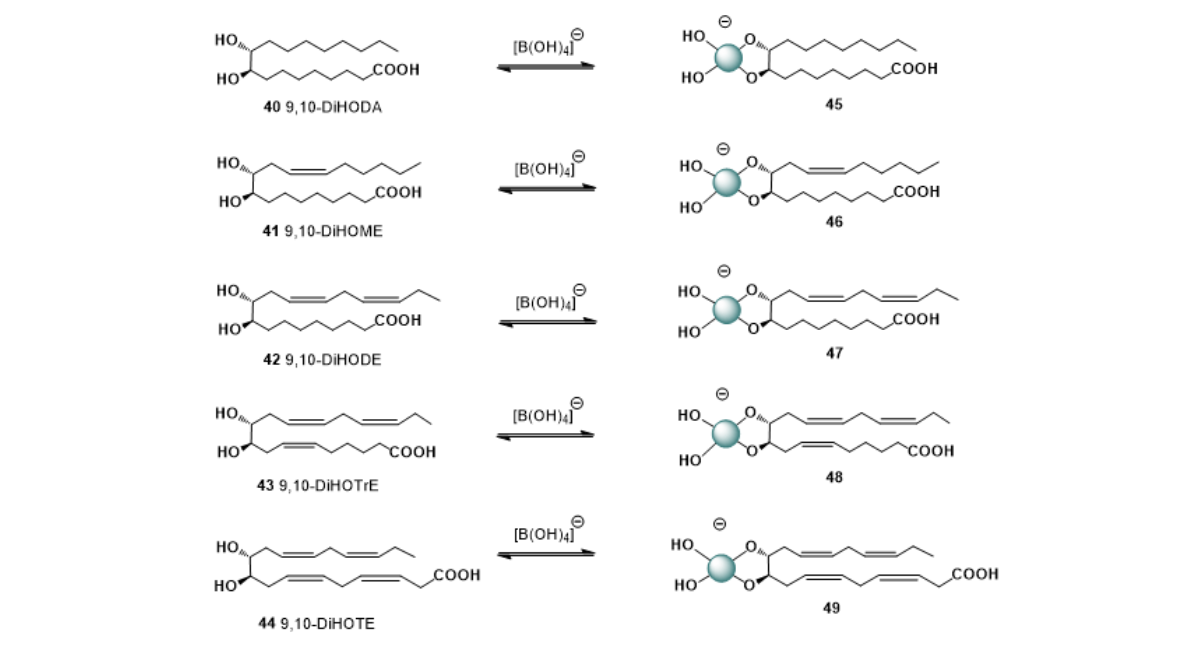
Figure 5: Schematic diagram of the formation of cosmetically active boron complexes of the C18 oxylipin family, namely 9,10-dihydroxy derivatives of mono-, di-, tri-, and tetra-unsaturated octadecenoic acids. The scheme illustrates coordination of the 9,10-cis-vicinal diol group to borate species under alkaline conditions, forming five-membered cyclic boronate esters with tetrahedral boron geometry. The unsaturated double bonds present along the hydrocarbon chain do not participate directly in coordination and therefore do not hinder complex formation. These reversible boron-diol interactions may influence amphiphilic behavior, film-forming properties, and controlled release potential in dermatological and cosmetic formulations.
A family of C18 oxylipins, namely 9,10-dihydroxy derivatives of mono-, di-, tri-, and tetra-unsaturated octadecenoic acids, react with boron anions in alkaline media to form the corresponding boron complexes (46-49). The coordination occurs specifically at the 9,10-cis-vicinal diol moiety, which serves as the primary chelation site for boron. The presence, number, and position of carbon-carbon double bonds along the aliphatic chain do not interfere with boron complex formation, as they are electronically and spatially remote from the diol functionality. Thus, unsaturation in the hydrocarbon chain does not significantly affect the ability of these oxylipins to generate stable cyclic boronate esters under alkaline conditions [165,168,178-181].
The corresponding borate complexes introduce an additional dimension. The 9,10-vicinal diol can form cyclic borate or boronate esters that are reversible and responsive to pH and competing diols. This dynamic covalent interaction may enhance film formation, improve substantivity, modulate oxidation stability of highly unsaturated species, and potentially enable controlled release of the free diol on the skin surface. Boron-diol interactions may also contribute to weak supramolecular network formation, influencing rheology and texture in topical formulations. Nevertheless, regulatory and toxicological considerations are significant, as boric acid and related borates are subject to restrictions in several jurisdictions. Therefore, while the free acids show potential as barrier-supporting and inflammation-modulating lipid actives, and their boron complexes offer intriguing formulation advantages, further mechanistic, safety, and clinical studies are essential to substantiate their role as protective agents in dermatology and cosmetic science [182-186].
Use of boron-diol complexes in cosmetic formulations
At present, the application of boron-diol complexes in cosmetic formulations appears to lie at the interface between established practice and emerging research. Certain boron-polyol systems, particularly those based on widely used ingredients such as sorbitol, mannitol, and gluconolactone, are indirectly represented in commercial products where boric acid or borate-buffered systems coexist with diol-containing compounds. However, in many cases, the presence of discrete, well-defined boron-diol complexes is not explicitly reported, as these interactions are reversible, formulation-dependent, and often not isolated as individual ingredients. Consequently, much of the detailed structural and mechanistic understanding of these complexes originates from laboratory studies rather than from fully characterized commercial systems. This distinction reflects both analytical challengesdue to the transient nature of boronate ester formationand regulatory and formulation practices, which typically focus on bulk ingredient functionality rather than dynamic supramolecular species. Therefore, while the underlying chemistry is already relevant to existing formulations, the deliberate design and optimization of boron-diol complexes as functional entities remain an emerging area with significant potential for future cosmetic and dermatological applications [187-196].
Prospects for the Use of Boron-Containing Compounds in Cosmetology
The prospects for using the presented vicinal diol compounds and their boron complexes in cosmetology are scientifically promising and conceptually innovative. These systems combine well-established hydroxy acid functionalitysuch as controlled exfoliation, hydration enhancement, antioxidant stabilization, and microbiome modulationwith the dynamic and reversible coordination chemistry of boron. Boron complexation offers the potential to regulate effective acidity, reduce irritation, enable controlled release of active species, improve oxidative stability, and enhance film-forming or rheological properties in topical formulations [28,36,55]. In addition, emerging evidence suggests that certain boron-organic acid systems may interfere with bacterial quorum sensing and biofilm formation, opening avenues for microbiome-conscious skincare strategies, particularly in acne-prone or sensitive skin (Figure 5). The structural diversity of the compounds reviewedranging from small α-hydroxy acids and sugar acids to polyols and lipid-derived diolsprovides a versatile platform adaptable to moisturizers, anti-aging products, barrier-repair formulations, and protective skin treatments [22,23,54,60,87,187]. However, successful translation into commercial applications will require careful optimization of concentration, formulation design, and regulatory compliance regarding boron content, as well as comprehensive safety and clinical validation. Overall, these boron-vicinal diol systems represent a promising direction for next-generation multifunctional cosmetic ingredients with potential to enhance both efficacy and tolerability [28,33,87,188-192].
Prospects for the Use of Boron-Containing Compounds in Dermatology
Boron-containing compounds represent a promising and still underexplored class of functional agents in dermatology, offering a unique combination of chemical versatility, reversible reactivity, and biological compatibility. Owing to their ability to form dynamic complexes with cis-vicinal diols, boron species can interact with a wide range of biologically relevant molecules, including sugars, polyols, hydroxy acids, and glycan-rich structures present at the skin surface. This reversible coordination chemistry enables boron to modulate key physicochemical properties such as acidity, solubility, stability, and molecular organization, thereby providing opportunities for the development of advanced dermatological formulations. In particular, boron-diol interactions may support controlled release of active ingredients, reduce irritation associated with free acids, and enhance hydration through the formation of weak supramolecular networks that improve film formation and reduce transepidermal water loss. In addition, boron-containing systems have demonstrated antioxidant and metal-chelating properties, which may contribute to protection against oxidative stress and environmental damage, both of which are central factors in skin aging and inflammatory conditions [193-196].
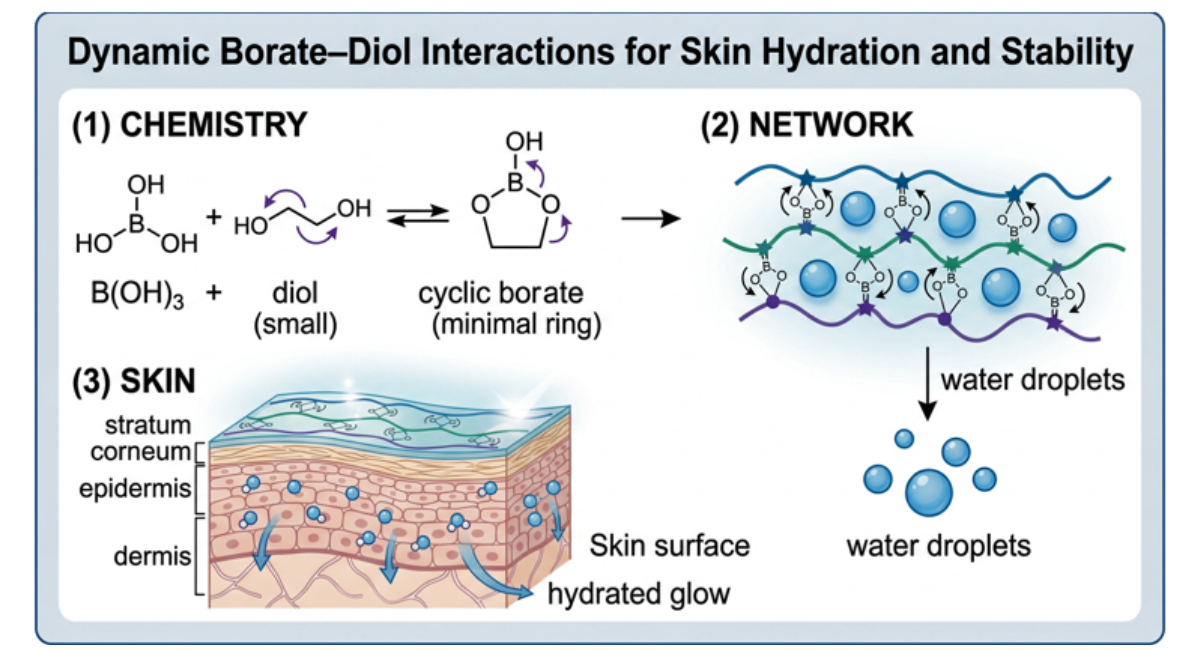
Figure 6: Dynamic borate-diol interactions as a conceptual mechanism for skin hydration and barrier stabilization. (1) Boric acid (B(OH)₃) undergoes reversible coordination with vicinal diols to form cyclic borate esters through dynamic covalent interactions. (2) Reversible borate-diol cross-linking generates a transient supramolecular network capable of retaining and organizing water molecules, thereby promoting hydration and structural stability at the molecular level. (3) At the skin surface, these dynamic interactions are proposed to enhance water retention within the stratum corneum, strengthen the hydrated intercellular matrix, and improve skin barrier function, resulting in enhanced skin hydration, elasticity, smoothness, and a healthy hydrated appearance. The figure illustrates a conceptual mechanism by which reversible borate-diol chemistry may contribute to cosmetic formulations designed to improve skin moisturization and barrier integrity.
Beyond these physicochemical effects, boron compounds may also play a role in modulating the skin microbiome. Emerging evidence suggests that boron-containing molecules can influence bacterial quorum sensing and biofilm formation, offering a strategy to attenuate microbial virulence without exerting strong selective pressure for resistance. This property is particularly relevant for the management of acne, seborrheic dermatitis, and other microbiome-associated disorders, where maintaining microbial balance is preferable to broad-spectrum antimicrobial approaches. Furthermore, the compatibility of boron-polyol and boron-sugar acid systems with endogenous skin components, including glycosaminoglycans and extracellular matrix constituents, suggests that these compounds may support barrier function and tissue homeostasis [197-198].
At the same time, the practical implementation of boron-containing compounds in dermatology requires careful consideration of safety, regulatory constraints, and formulation stability. The bioavailability of free boron species, potential systemic exposure, and concentration-dependent toxicity must be rigorously controlled, particularly in leave-on products. Importantly, complexation with diol-containing ligands may reduce free borate levels and improve tolerability, although this effect requires further quantitative validation. In addition, the dynamic and pH-dependent nature of boron coordination introduces formulation challenges, as the stability and functionality of these complexes depend on environmental conditions such as pH, ionic strength, and the presence of competing ligands [22,23,28,36].
Overall, boron-containing compounds offer a versatile platform for next-generation dermatological applications, bridging coordination chemistry with skin biology. Their ability to function as reversible molecular connectors rather than static ingredients provides a conceptual shift toward adaptive, responsive formulations (see Table 2). Future research should focus on elucidating the kinetics and thermodynamics of boron-diol interactions under physiological conditions, developing analytical tools to detect transient complexes in situ, and conducting well-designed in vivo and clinical studies to establish efficacy and safety. Such efforts will determine whether boron-based systems can transition from promising chemical constructs to practical and widely adopted dermatological technologies [199-205].
CONCLUSION
Vicinal diol-containing compounds constitute a chemically coherent yet biologically diverse class of molecules whose relevance to cosmetology and dermatology extends far beyond traditional exfoliation chemistry. The unifying structural feature across the systems examined in this reviewα,β-diol or cis-vicinal diol functionalityconfers a pronounced ability to form reversible coordination complexes with boron species. Whether present in classical α-hydroxy acids (glycolic, lactic, malic, tartaric), β-hydroxy aromatic systems (salicylic acid), sugar acids (gluconic, glucuronic, glucaric), polyols (mannitol, sorbitol, mannose), L-ascorbic acid, or C18 oxylipin derivatives such as 9,10-dihydroxy unsaturated fatty acids, the stereochemical requirement for boron complexation remains consistent: properly oriented cis-vicinal hydroxyl groups capable of generating low-strain five-membered cyclic borate esters.
The chemistry of boron-diol interactions is characterized by dynamic, reversible, and pH-dependent equilibria. Upon coordination, boron transitions from trigonal planar (sp²) to tetrahedral (sp³) geometry, forming cyclic borate structures that can significantly alter physicochemical properties. These changes may include modulation of effective acidity, altered solubility and lipophilicity, modified membrane interactions, enhanced oxidative stability, metal chelation, and controlled release behavior. Importantly, stereochemical orientationparticularly erythro-type (cis) diol arrangementsgoverns complex stability, emphasizing the structural selectivity underlying boron coordination.
From a dermatological perspective, the implications are substantial. Boron complexation offers a potential strategy to moderate irritation associated with free hydroxy acids by reducing immediate availability of active protonated species while preserving long-term efficacy. In polyhydroxy and sugar acid systems, complex formation may enhance hydration and barrier-support effects through reversible supramolecular interactions at the skin surface. In lipid-derived diols, such as C18 oxylipins, boron binding does not interfere with double-bond unsaturation but selectively targets the vicinal diol, potentially enabling amphiphilic film formation and surface substantivity without compromising lipid functionality.
Moreover, emerging evidence suggests that certain boron-organic acid complexes may influence microbial communication pathways, including quorum sensing and biofilm formation. Such anti-virulence strategies represent a promising direction for acne-prone and microbiome-conscious skincare, offering modulation of pathogenic behavior without strong bactericidal pressure that could promote antimicrobial resistance. In addition, stabilization of antioxidants such as L-ascorbic acid through boron coordination may enhance resistance to oxidative degradation and improve formulation longevity.
Despite these promising attributes, translation into clinical cosmetology requires careful consideration of regulatory frameworks governing boron-containing compounds, particularly with respect to systemic exposure and concentration limits. Safety evaluation, skin penetration studies, toxicological profiling, and well-designed clinical trials remain essential steps before widespread implementation. The reversible nature of boron-diol chemistry may offer opportunities to optimize bioavailability while minimizing risk, but such advantages must be validated experimentally.
Overall, the collective data support the view that boron complexes of vicinal diol compounds represent a versatile and innovative platform in cosmetic science. By integrating principles of coordination chemistry with dermatological functionality, these systems provide a bridge between molecular structure and biological performance. Across hydroxy acids, sugar acids, polyols, antioxidant systems, and lipid-derived diols, boron complexation consistently introduces multifunctional potentialcontrolled activity, improved tolerability, oxidative stabilization, microbiome modulation, and enhanced formulation performance.
Thus, all boron complexes discussed in this review are of considerable potential interest in cosmetology and, more broadly, in dermatology. Their future impact will depend on continued interdisciplinary research that integrates organic chemistry, materials science, microbiology, skin biology, and regulatory science. If successfully developed and validated, boron-vicinal diol systems may represent a new generation of multifunctional cosmetic agents designed not merely to treat the skin surface, but to interact dynamically with its biochemical and microbial environment.
AUTHOR CONTRIBUTION
Conceptualization, V.M.D.; methodology, V.M.D.; O.A.R.; S.V.B.; software, A.O.T.; investigation, V.M.D.; O.A.R.; S.V.B. resources, V.M.D.; writingoriginal draft preparation, A.O.T., V.M.D.; writingreview and editing, A.O.T., and V.M.D. All authors have read and agreed to the published version of the manuscript.
INSTITUTIONAL REVIEW BOARD STATEMENT
Not applicable.
INFORMED CONSENT STATEMENT
Not applicable.
DATA AVAILABILITY STATEMENT
No new data were created or analyzed in this study. Data sharing is not applicable to this article.
FUNDING
This research received no funding.
CONFLICT OF INTEREST
The authors declare no conflicts of interest.
REFERENCES
- Xiang J, Gong X, Lu L, Fang F, Feng Y, Shi X. Spectroscopic identification of 10 α-hydroxy acid substances in cosmetics. China Surfactant Deterg Cosmet. 2025;55(11):1486. [Google Scholar]
- Kornhauser A, Coelho SG, Hearing VJ. Applications of hydroxy acids: classification, mechanisms, and photoactivity. Clin Cosmet Investig Dermatol. 2010;3:135-142. [Crossref] [Google Scholar] [PubMed]
- Egli C, Min M, Afzal N, Sivamani RK. The hydroxy acids: Where have we been and what's new?. Dermatol Rev. 2023;4(6):260-267. [Crossref] [Google Scholar]
- Babilas P, Knie U, Abels C. Cosmetic and dermatologic use of alpha hydroxy acids. J Dtsch Dermatol Ges. 2012;10(7):488-491. [Crossref] [Google Scholar] [PubMed]
- Saint-Léger D, Lévêque JL, Verschoore M. The use of hydroxy acids on the skin: characteristics of C8-lipohydroxy acid. J Cosmet Dermatol. 2007;6(1):59-65. [Crossref] [Google Scholar] [PubMed]
- Dembitsky VM, Řezanka T, Shubinat EE. Unusual hydroxy fatty acids from some higher fungi. Phytochemistry. 1993;34(4):1057-1059. [Crossref] [Google Scholar]
- Řezanka T, Rozentsvet OA, Dembitsky VM. Characterization of the hydroxy fatty acid content of Basidiomycotina. Folia Microbiol. 1999;44(6):635-641. [Crossref] [Google Scholar]
- Dembitsky VM. Hydrobiological aspects of fatty acids: unique, rare, and unusual fatty acids incorporated into linear and cyclic lipopeptides and their biological activity. Hydrobiology. 2022;1(3):331-432. [Crossref] [Google Scholar]
- Li D, Zhao X, Zhou Q, Ding B, Zheng A, Peng Q, Hou Z. Vicinal hydroxyl group-inspired selective oxidation of glycerol to glyceric acid on hydroxyapatite supported Pd catalyst. Green Energy Environ. 2022;7(4):691-703. [Crossref] [Google Scholar]
- Klein RA. Lack of intramolecular hydrogen bonding in glucopyranose: vicinal hydroxyl groups exhibit negative cooperativity. Chem Phys Lett. 2006;433(1-3):165-169. [Crossref] [Google Scholar]
- Biely P, Mastihubová M, Puchart V. The vicinal hydroxyl group is prerequisite for metal activation of Clostridium thermocellum acetylxylan esterase. Biochim Biophys Acta. 2007;1770(4):565-570. [Crossref] [Google Scholar] [PubMed]
- Cramer J, Sager CP, Ernst B. Hydroxyl groups in synthetic and natural-product-derived therapeutics: a perspective on a common functional group. J Med Chem. 2019;62(20):8915-8930. [Crossref] [Google Scholar] [PubMed]
- Ren B, Zhang L, Zhang M. Progress on selective acylation of carbohydrate hydroxyl groups. Asian J Org Chem. 2019;8(10):1813-1823. [Crossref] [Google Scholar]
- Anastassiadis S, Morgunov IG. Gluconic acid production. Recent Pat Biotechnol. 2007;1(2):167-180. [Crossref] [Google Scholar] [PubMed]
- Mehtiö T, Toivari M, Wiebe MG, Harlin A, Penttilä M, Koivula A. Production and applications of carbohydrate-derived sugar acids as generic biobased chemicals. Crit Rev Biotechnol. 2016;36(5):904-916. [Crossref] [Google Scholar] [PubMed]
- Pal P, Kumar R, Banerjee S. Manufacture of gluconic acid: a review towards process intensification for green production. Chem Eng Process. 2016;104:160-171. [Crossref] [Google Scholar]
- Mattey M. The production of organic acids. Crit Rev Biotechnol. 1992;12(1-2):87-132. [Crossref] [Google Scholar] [PubMed]
- Sauer M, Porro D, Mattanovich D, Branduardi P. Microbial production of organic acids: expanding the markets. Trends Biotechnol. 2008;26(2):100-108. [Crossref] [Google Scholar] [PubMed]
- Primas N, Bouillon A, Rault S. Recent progress in the synthesis of five-membered heterocycle boronic acids and esters. Tetrahedron. 2010;66(41):8121-8136. [Crossref] [Google Scholar]
- Van Duin M. Borate Esters: Identification, Structure, Stability, and Cation Coordinating Ability. Delft: Delft University Press; 1986. [Google Scholar]
- Dale J. The stereochemistry of polyborate anions and of borate complexes of diols and certain polyols. J Chem Soc. 1961:922-930. [Crossref] [Google Scholar]
- Dembitsky VM, Terent'ev AO, Baranin SV, Gursky ME. Aromatic compounds and their fascinating boron complexes as potential quorum sensing molecules. Vietnam J Chem. 2025;63(6):883-911. [Crossref] [Google Scholar]
- Dembitsky VM, Terent'ev AO, Baranin SV. Boronosteroids as potential antitumor drugs: a review. Tumor Discov. 2025;025290069. [Crossref] [Google Scholar]
- Miyazaki Y, Yoshimura K, Miura Y, Sakashita H, Ishimaru K. ¹¹B NMR investigation of the complexation behavior of borate with polysaccharides in aqueous solution. Polyhedron. 2003;22(6):909-916. [Crossref] [Google Scholar]
- Yoshimura K, Miyazaki Y, Sawada S, Waki H. ¹¹B NMR studies on complexation of borate with linear and crosslinked polysaccharides. J Chem Soc Faraday Trans. 1996;92(4):651-656. [Crossref] [Google Scholar]
- Shao C, Miyazaki Y, Matsuoka S, Yoshimura K, Sakashita H. Complexation of borate with cross-linked polysaccharide anion exchanger: ¹¹B NMR and adsorption properties studies. Macromolecules. 2000;33(1):19-25. [Crossref] [Google Scholar]
- Sanfeliu C, Martínez-Máñez R, Sancenón F, Soto J, Amorós P, Azaïs T, Marcos MD. ¹¹B-MAS NMR approach to the boron adsorption mechanism on a glucose-functionalised mesoporous silica matrix. Microporous Mesoporous Mater. 2018;266:232-241. [Crossref] [Google Scholar]
- Ali HA, Dembitsky VM, Srebnik M. Contemporary aspects of boron: chemistry and biological applications. J Organomet Chem. 2005;690(16):3740-3752. [Google Scholar]
- Chatterjee S, Tripathi NM, Bandyopadhyay A. The modern role of boron as a "magic element" in biomedical science: chemistry perspective. Chem Commun. 2021;57(100):13629-13640. [Crossref] [Google Scholar] [PubMed]
- Taylor MS. Catalysis based on reversible covalent interactions of organoboron compounds. Acc Chem Res. 2015;48(2):295-305. [Crossref] [Google Scholar] [PubMed]
- Kwart H, Gatos GC. Factors involved in the stereochemistry of diol complexes. J Am Chem Soc. 1958;80(4):881-883. [Crossref] [Google Scholar]
- Pappin B, Kiefel MJ, Houston TA. Boron–carbohydrate interactions. In: Chang CF, editor. Carbohydrates-Comprehensive Studies on Glycobiology and Glycotechnology. Rijeka: IntechOpen; 2012. p. 37-54. [Crossref] [Google Scholar]
- Tevyashova AN, Chudinov MV. Progress in the medicinal chemistry of organoboron compounds. Russ Chem Rev. 2021;90(4):451-487. [Crossref] [Google Scholar]
- Cai SX, Keana JF. o-Acetamidophenylboronate esters stabilized toward hydrolysis by an intramolecular oxygen–boron interaction: potential linkers for selective bioconjugation via vicinal diol moieties of carbohydrates. Bioconjugate Chem. 1991;2(5):317-322. [Crossref] [Google Scholar] [PubMed]
- Scorei R. Is boron a prebiotic element? A mini-review of the essentiality of boron for the appearance of life on earth. Orig Life Evol Biosph. 2012;42(1):3-17. [Crossref] [Google Scholar] [PubMed]
- Dembitsky VM, Smoum R, Al-Quntar AA, Ali HA, Pergament I, Srebnik M. Natural occurrence of boron-containing compounds in plants, algae and microorganisms. Plant Sci. 2002;163(5):931-942. [Crossref] [Google Scholar]
- Gilmour GVB. Reactions of sugars and polyatomic alcohols in boric acid and borate solutions, with some analytical applications. Analyst. 1921;46(537):3-10. [Crossref] [Google Scholar]
- Böeseken J. The use of boric acid for the determination of the configuration of carbohydrates. Adv Carbohydr Chem. 1949;4:189-210. [Crossref] [Google Scholar]
- Davis HB, Mott CJ. Interaction of boric acid and borates with carbohydrates and related substances. J Chem Soc Faraday Trans 1. 1980;76:1991-2002. [Crossref] [Google Scholar]
- Bancroft WD, Davis HL. The boric acid problem. J Phys Chem. 1930;34(11):2479-2507. [Crossref] [Google Scholar]
- Wei P, Atwood DA. Chelated borates: synthesis, reactivity, and cation formation. Inorg Chem. 1998;37(19):4934-4938. [Crossref] [Google Scholar] [PubMed]
- Lucchesi CA. Study of Chelating Agents for the Determination of Boric Acid in Aqueous Solution. Evanston, IL: Northwestern University; 1955. [Google Scholar]
- Köse DA, Zümreoglu-Karan B. Mixed-ligand complexes of boric acid with organic biomolecules. Chem Pap. 2012;66(1):54-60. [Crossref] [Google Scholar]
- Shao C, Matsuoka S, Miyazaki Y, Yoshimura K. Studies on the complexation of boric acid with polyhydroxyl compounds. Anal Sci Suppl. 2002;17:i1475-i1478. [Google Scholar]
- Bacchiocchi C, Petroselli M. Elucidation of the mechanism of the esterification of boric acid with aliphatic diols: a computational study to help set the record straight. Chem Commun. 2024;60(92):13239-13242. [Crossref] [Google Scholar] [PubMed]
- Viso A, Fernández de la Pradilla R, Tortosa M. Site-selective functionalization of C(sp³) vicinal boronic esters. ACS Catal. 2022;12(17):10603-10620. [Crossref] [Google Scholar]
- Sato D, Nitanda K, Nishiyori R, Shimada N. Boronic acid catalysis for diol activation under Lewis base promotion: site-selective propargylation of carbohydrates. ACS Catal. 2025;16(2):752-765. [Crossref] [Google Scholar]
- Coddington JM, Taylor MJ. High-field ¹¹B and ¹³C NMR investigations of aqueous borate solutions and borate–diol complexes. J Coord Chem. 1989;20(1):27-38. [Crossref] [Google Scholar]
- Maseda M, Miyazaki Y, Takamuku T. Thermodynamics for complex formation of boric acid and borate with hydroxy acids and diols. J Mol Liq. 2021;341:117343. [Crossref] [Google Scholar]
- Da Silva JAL. Borate esters of polyols: occurrence, applications and implications. Inorg Chim Acta. 2021;520:120307. [Crossref] [Google Scholar]
- Van Duin M, Baas JM, Van de Graaf B. Empirical force field calculations. 27. A study on the conformations of the simple vicinal diols. J Org Chem. 1986;51(8):1298-1302. [Crossref] [Google Scholar]
- Babcock L, Pizer R. Dynamics of boron acid complexation reactions: formation of 1:1 boron acid–ligand complexes. Inorg Chem. 1980;19(1):56-61. [Crossref] [Google Scholar]
- Kochkodan V, Darwish NB, Hilal N. The chemistry of boron in water. In: Boron Separation Processes. Amsterdam: Elsevier; 2015. p. 35-63. [Crossref] [Google Scholar]
- Abdou-Mohamed A, Aupic C, Fournet C, Parrain JL, Chouraqui G, Chuzel O. Stereoselective formation of boron-stereogenic organoboron derivatives. Chem Soc Rev. 2023;52(13):4381-4391. [Crossref] [Google Scholar] [PubMed]
- Smoum R, Rubinstein A, Dembitsky VM, Srebnik M. Boron-containing compounds as protease inhibitors. Chem Rev. 2012;112(7):4156-4220. [Crossref] [Google Scholar] [PubMed]
- Arrigoni O, De Tullio MC. Ascorbic acid: much more than just an antioxidant. Biochim Biophys Acta. 2002;1569(1-3):1-9. [Crossref] [Google Scholar] [PubMed]
- Du J, Cullen JJ, Buettner GR. Ascorbic acid: chemistry, biology and the treatment of cancer. Biochim Biophys Acta Rev Cancer. 2012;1826(2):443-457. [Crossref] [Google Scholar] [PubMed]
- Njus D, Kelley PM, Tu YJ, Schlegel HB. Ascorbic acid: the chemistry underlying its antioxidant properties. Free Radic Biol Med. 2020;159:37-43. [Crossref] [Google Scholar] [PubMed]
- Zümreoglu-Karan B, Köse DA. Boric acid: a simple molecule of physiologic, therapeutic and prebiotic significance. Pure Appl Chem. 2015;87(2):155-162. [Crossref] [Google Scholar]
- Yunusoglu O, Kalfa I, Demirel ME, Binzet MA, Sevinc UZ, Turel I, Kurt AH. A comprehensive review of the pharmacological, therapeutic, and toxicological properties of boric acid and other boron-containing compounds: current landscape and future perspectives. Pharmacy. 2025;13(1):202. [Crossref] [Google Scholar]
- Köse DA, Zümreoglu-Karan B. Complexation of boric acid with vitamin C. New J Chem. 2009;33(9):1874-1881. [Crossref] [Google Scholar]
- Ahmad I, Ali Sheraz M, Ahmed S, Shad Z, Vaid FHM. Photostabilization of ascorbic acid with citric acid, tartaric acid and boric acid in cream formulations. Int J Cosmet Sci. 2012;34(3):240-245. [Crossref] [Google Scholar] [PubMed]
- Obi N, Katayama M, Sano J, Kojima Y, Shigemitsu Y, Takada K. NMR spectroscopic study of the formation of borate esters of ascorbic acid and isoascorbic acid. New J Chem. 1998;22(9):933-934. [Crossref] [Google Scholar]
- Pappenberger G, Hohmann HP. Industrial production of L-ascorbic acid (vitamin C) and D-isoascorbic acid. In: Biotechnology of Food and Feed Additives. Berlin: Springer; 2013. p. 143-188. [Crossref] [Google Scholar] [PubMed]
- Hancock RD, Viola R. Biotechnological approaches for L-ascorbic acid production. Trends Biotechnol. 2002;20(7):299-305. [Crossref] [Google Scholar] [PubMed]
- Boudrant J. Microbial processes for ascorbic acid biosynthesis: a review. Enzyme Microb Technol. 1990;12(5):322-329. [Crossref] [Google Scholar] [PubMed]
- Gad AAM, Sirko A. L-gulono-γ-lactone oxidase, the key enzyme for L-ascorbic acid biosynthesis. Curr Issues Mol Biol. 2024;46(10):11057-11074. [Crossref] [Google Scholar] [PubMed]
- Pappenberger G, Hohmann HP. Direct microbial routes to vitamin C production. In: Industrial Biotechnology of Vitamins, Biopigments, and Antioxidants. 2016;193-225. [Crossref] [Google Scholar]
- Smirnoff N, Wheeler GL. Ascorbic acid in plants: biosynthesis and function. Crit Rev Plant Sci. 2000;19(4):267-290. [Crossref] [Google Scholar] [PubMed]
- Running JA, Peng S, Rosson RA. The biotechnology of ascorbic acid manufacture. In: Vitamin C. Boca Raton, FL: Taylor & Francis; 2004. p. 55-72. [Google Scholar]
- Siebeneichler TJ, Lopes Crizel R, Rombaldi CV, Kremer FS, Machado CDS, Sanchez CD, Galli V. Small RNAs, big impact: miRNAs and circRNAs in the post-transcriptional control of fruit ripening. Crit Rev Plant Sci. 2026;45:1-27. [Google Scholar]
- Yang W, Xu H. Industrial fermentation of vitamin C. In: Industrial Biotechnology of Vitamins, Biopigments, and Antioxidants.2016;161-192. [Crossref] [Google Scholar]
- Zou W, Liu L, Zhang J, Yang H, Zhou M, Hua Q, Chen J. Reconstruction and analysis of a genome-scale metabolic model of the vitamin C-producing industrial strain Ketogulonicigenium vulgare WSH-001. J Biotechnol. 2012;161(1):42-48. [Crossref] [Google Scholar] [PubMed]
- Sugisawa T, Miyazaki T, Hoshino T. Microbial production of L-ascorbic acid from D-sorbitol, L-sorbose, L-gulose, and L-sorbosone by Ketogulonicigenium vulgare DSM 4025. Biosci Biotechnol Biochem. 2005;69(3):659-662. [Crossref] [Google Scholar] [PubMed]
- Zhang Q, Lyu S. Microbial interactions in a vitamin C industrial fermentation system: novel insights and perspectives. Appl Environ Microbiol. 2022;88(15):e01212-22. [Crossref] [Google Scholar] [PubMed]
- Rebstöcková M, Bartušek M. Reactions of boric acid with oxalic, glycolic and tartaric acids. Collect Czech Chem Commun. 1977;42(2):627-636. [Crossref] [Google Scholar]
- Qin R, Chen H, Wen R, Li G, Meng Z. Effect of boric acid on the ionization equilibrium of α-hydroxy carboxylic acids and the study of its applications. Molecules. 2023;28(12):4723. [Crossref] [Google Scholar] [PubMed]
- Pizer R, Selzer R. The boric acid/lactic acid system: equilibria and reaction mechanism. Inorg Chem. 1984;23(19):3023-3026. [Crossref] [Google Scholar]
- Svishcheva NB, Khaptakhanova PA, Kasatov DA, Uspenskii SA. Preparation and study of properties of boron-containing polymer based on lactic and boric acids. Russ Chem Bull. 2021;70(9):1725-1728. [Crossref] [Google Scholar]
- Svishcheva NB, Uspenskii SA, Sedush NG, Khaptakhanova PA, Kasatova AI, Buzin AI, Taskaev SY. Biodegradable boron-containing poly(lactic acid) for fertilizers with prolonged action. Mater Today Commun. 2022;33:104514. [Crossref] [Google Scholar]
- Li Y, Xu Y, Liu Y, Bao X. Recent advances in medically oriented research on lactic acid detection. Chem Pap. 2025;79(3):1335-1353. [Crossref] [Google Scholar]
- Pal R. Boric acid in organic synthesis: scope and recent developments. ARKIVOC. 2018;2018(i):1-25. [Crossref] [Google Scholar]
- Livingston GE. Malic acid–fructose reaction. J Am Chem Soc. 1953;75(6):1342-1344. [Crossref] [Google Scholar]
- Houston TA, Wilkinson BL, Blanchfield JT. Boric acid catalyzed chemoselective esterification of α-hydroxycarboxylic acids. Org Lett. 2004;6(5):679-681. [Crossref] [Google Scholar] [PubMed]
- Kustin K, Pizer R. Temperature-jump study of the rate and mechanism of the boric acid–tartaric acid complexation. J Am Chem Soc. 1969;91(2):317-322. [Crossref] [Google Scholar]
- Tahara N, Kakiage M, Yanase I, Kobayashi H. Effect of addition of tartaric acid on synthesis of boron carbide powder from condensed boric acid–glycerin product. J Alloys Compd. 2013;573:58-64. [Crossref] [Google Scholar]
- Dembitsky VM, Terent'ev AO, Stolbov LA, Pogodin PV, Filimonov DA, Poroikov VV. Salicylic acid and its boron complexes as quorum sensing molecules. Mol Pharm. 2025;22(12):6499-6509. [Crossref] [Google Scholar] [PubMed]
- Pascher FR. Systemic reactions to topically applied drugs. Howard Fox memorial lecture. Bull N Y Acad Med. 1973;49(7):613-630. [Google Scholar] [PubMed] [Crossref]
- Yanchimpee P, Thawornchaisit U. Decolorization of boron-based wood preservatives by ozonation for recycling: optimization of process parameters. Trends Sci. 2022;19(19):1788. [Crossref] [Google Scholar]
- Danilov AM, Bartko RV, Antonov SA. Current advances in the application and development of lubricating oil additives. Pet Chem. 2021;61(1):35-42. [Crossref] [Google Scholar]
- Queen A. The kinetics of the reaction of boric acid with salicylic acid. Can J Chem. 1977;55(17):3035-3039. [Crossref] [Google Scholar]
- Özdemir T, Keskiner AÜ. Spectroscopic analysis of the boric acid and salicylic acid–boric acid–ethanol solution. J Boron. 2018;3(3):118-125. [Crossref] [Google Scholar]
- Mehtiö T, Toivari M, Wiebe MG, Harlin A, Penttilä M, Koivula A. Production and applications of carbohydrate-derived sugar acids as generic biobased chemicals. Crit Rev Biotechnol. 2016;36(5):904-916. [Crossref] [Google Scholar] [PubMed]
- Peters JA. Interactions between boric acid derivatives and saccharides in aqueous media: structures and stabilities of resulting esters. Coord Chem Rev. 2014;268:1-22. [Crossref] [Google Scholar]
- Hunter JM, Nemzer BV, Rangavajla N, Biță A, Rogoveanu OC, Neamțu J, Mogoșanu GD. The fructoborates: part of a family of naturally occurring sugar–borate complexes—biochemistry, physiology, and impact on human health: a review. Biol Trace Elem Res. 2019;188(1):11-25. [Crossref] [Google Scholar] [PubMed]
- Scorei RI, Popa R. Sugar–borate esters—potential chemical agents in prostate cancer chemoprevention. Anticancer Agents Med Chem. 2013;13(6):901-909. [Crossref] [Google Scholar] [PubMed]
- Van Haveren J, Lammers H, Peters JA, Batelaan JG, Van Bekkum H. Formation of borate esters from, and sequestration of metal ions by, bis(polyhydroxyalkyl) amines and their N-carboxymethyl derivatives studied by ¹¹B and ¹³C NMR spectroscopy. Carbohydr Res. 1993;243(2):259-271. [Crossref] [Google Scholar]
- Takahashi Y, Kim HJ, Benner SA, Kakegawa T, Furukawa Y. Ribose accumulation in borate-rich prebiotic environments. Astrobiology. 2025. [Crossref] [Google Scholar] [PubMed]
- Abdel-Akher M, Hamilton JK, Smith F. The reduction of sugars with sodium borohydride. J Am Chem Soc. 1951;73(10):4691-4692. [Crossref] [Google Scholar]
- Sipes GE. Structure and Stability Constants of Boron, Calcium, and Magnesium Gluconate Chelates from Optical Rotation and Computer Analysis. Urbana, IL: University of Illinois at Urbana-Champaign; 1969. [Google Scholar]
- Bieringer E, García Vázquez U, Klein L, Moretó Bravo N, Tobler M, Weuster-Botz D. Bioproduction and applications of aldobionic acids with a focus on maltobionic and cellobionic acid. Bioprocess Biosyst Eng. 2023;46(7):921-940. [Crossref] [Google Scholar] [PubMed]
- Chatterjee C, Pong F, Sen A. Chemical conversion pathways for carbohydrates. Green Chem. 2015;17(1):40-71. [Crossref] [Google Scholar]
- Bielecki S. Enzymatic conversions of carbohydrates. In: Chemical and Functional Properties of Food Saccharides. Boca Raton, FL: CRC Press; 2003:131-158. [Google Scholar]
- Alekseev YE, Garnovskii AD, Zhdanov YA. Complexes of natural carbohydrates with metal cations. Russ Chem Rev. 1998;67(8):649-669. [Crossref] [Google Scholar]
- Meiberg JÁM, Van Bekkum H. New Ca-sequestering materials based on the oxidation of the hydrolysis products of lactose. Green Chem. 1999;1(5):231-235. [Crossref] [Google Scholar]
- Van Strien N, Rautiainen S, Asikainen M, Thomas DA, Linnekoski J, Niemelä K, Harlin A. A unique pathway to platform chemicals: Aldaric acids as stable intermediates for the synthesis of furandicarboxylic acid esters. Green Chem. 2020;22(23):8271-8277. [Crossref] [Google Scholar]
- Coutinho ID, Baker JM, Ward JL, Beale MH, Creste S, Cavalheiro AJ. Metabolite profiling of sugarcane genotypes and identification of flavonoid glycosides and phenolic acids. J Agric Food Chem. 2016;64(21):4198-4206. [Crossref] [Google Scholar] [PubMed]
- Inoue Y, Yamamoto A. Stationary phases for the separation of reducing sugars by normal-phase partition chromatography. Chromatography. 2014;35(2):63-72. [Crossref] [Google Scholar]
- Bedford CT. Glucuronic acid conjugates. J Chromatogr B. 1998;717(1-2):313-326. [Crossref] [Google Scholar] [PubMed]
- Bailey MJ, Dickinson RG. Acyl glucuronide reactivity in perspective: Biological consequences. Chem Biol Interact. 2003;145(2):117-137. [Crossref] [Google Scholar] [PubMed]
- Shipkova M, Armstrong VW, Oellerich M, Wieland E. Acyl glucuronide drug metabolites: Toxicological and analytical implications. Ther Drug Monit. 2003;25(1):1-16. [Crossref] [Google Scholar] [PubMed]
- Funakawa H, Miwa K. Synthesis of borate cross-linked rhamnogalacturonan II. Front Plant Sci. 2015;6:223. [Crossref] [Google Scholar] [PubMed]
- O'Neill MA, Ishii T, Albersheim P, Darvill AG. Rhamnogalacturonan II: Structure and function of a borate cross-linked cell wall pectic polysaccharide. Annu Rev Plant Biol. 2004;55:109-139. [Crossref] [Google Scholar] [PubMed]
- Liu C, Lei F, Li P, Wang K, Jiang J. A review on preparations, properties, and applications of cis-ortho-hydroxyl polysaccharide hydrogels crosslinked with borax. Int J Biol Macromol. 2021;182:1179-1191. [Crossref] [Google Scholar] [PubMed]
- Ovodov YS. Chromatography of carbohydrates on ion-exchange resins. Russ Chem Rev. 1971;40(5):406-412. [Crossref] [Google Scholar]
- Isbell HS, Frush HL. Chemistry of the carbohydrates. Annu Rev Biochem. 1953;22(1):107-124. [Crossref] [Google Scholar] [PubMed]
- Zaborowski MK, Długosz A, Błaszak B, Szulc J, Leis K. The role of quercetin as a plant-derived bioactive agent in preventive medicine and treatment in skin disorders. Molecules. 2024;29(13):3206. [Crossref] [Google Scholar] [PubMed]
- Zhou L, Xu S, Li S. Microneedle-mediated transdermal drug delivery for the treatment of multiple skin diseases. Pharmaceutics. 2025;17(10):1281. [Crossref] [Google Scholar] [PubMed]
- Cai C, Li W, Zhang X, Cheng B, Chen S, Zhang Y. Natural polymer-based hydrogel dressings for wound healing. Adv Wound Care. 2025;14(6):295-322. [Crossref] [Google Scholar] [PubMed]
- Chen X, Jiang ZH, Chen S, Qin W. Microbial and bioconversion production of D-xylitol and its detection and application. Int J Biol Sci. 2010;6(7):834-844. [Crossref] [Google Scholar] [PubMed]
- Weser U. Chemistry and structure of some borate polyol compounds of biochemical interest. In: Structure and Bonding. Berlin: Springer; 2008:160-180. [Crossref] [Google Scholar]
- Livesey G. Health potential of polyols as sugar replacers, with emphasis on low glycaemic properties. Nutr Res Rev. 2003;16(2):163-191. [Crossref] [Google Scholar] [PubMed]
- Dills WL Jr. Sugar alcohols as bulk sweeteners. Annu Rev Nutr. 1989;9(1):161-186. [Crossref] [Google Scholar] [PubMed]
- Touster O, Shaw DRD. Biochemistry of the acyclic polyols. Physiol Rev. 1962;42(2):181-225. [Crossref] [Google Scholar] [PubMed]
- Zumbe A, Lee A, Storey D. Polyols in confectionery: The route to sugar-free, reduced sugar and reduced calorie confectionery. Br J Nutr. 2001;85(S1):S31-S45. [Crossref] [Google Scholar] [PubMed]
- Dembitsky VM. Boronolipids. Vietnam J Chem. 2025;63(4):373-384. [Crossref] [Google Scholar]
- Makkee M, Kieboom APG, Van Bekkum H. Studies on borate esters III. Borate esters of D-mannitol, D-glucitol, D-fructose and D-glucose in water. Recl Trav Chim Pays-Bas. 1985;104(9):230-235. [Crossref] [Google Scholar]
- Makkee M, Kieboom APG, Van Bekkum H, Roels JA. Combined Action of Enzyme and Metal Catalyst, Applied to the Preparation of D-Mannitol. Delft: Delft University Press; 1984. [Crossref] [Google Scholar]
- Miyazaki Y, Okita H, Maseda M. Complexation of borate with pentitols, hexitols and their derivatives as a functional group of a boron-selective adsorbent. Polyhedron. 2020;185:114580. [Crossref] [Google Scholar] [PubMed]
- Srinivasan M, Sreenivasaya M. The complexes of mannitol and sorbitol with sodium arsenite and borax. J Phys Chem. 1934;38(6):703-711. [Crossref] [Google Scholar]
- Pospíšilová M, Polášek M, Šafra J, Petriška I. Determination of mannitol and sorbitol in infusion solutions by capillary zone electrophoresis using on-column complexation with borate and indirect spectrophotometric detection. J Chromatogr A. 2007;1143(1-2):258-263. [Crossref] [Google Scholar] [PubMed]
- Awuchi CG. Sugar alcohols: Chemistry, production, health concerns and nutritional importance of mannitol, sorbitol, xylitol, and erythritol. Int J Adv Acad Res. 2017;3(11):31-66. [Google Scholar]
- Duggan PJ, Humphrey DG, McCarl V. Lipase-catalyzed 1,6-acylation of D-mannitol. Aust J Chem. 2004;57(8):741-745. [Crossref] [Google Scholar]
- Vajanthri KY. PVA–Bentonite Composite for Wound Dressing. 2014. [Google Scholar]
- Aruga R, Zerbinati O. Structures of the borate complexes with a tetritol, pentitols and hexitols in solution: A calorimetric study. J Therm Anal. 1989;35(5):1725-1731. [Crossref] [Google Scholar]
- Gece G, Bilgiç S. A computational study of two hexitol borates as corrosion inhibitors for steel. Int J Corros Scale Inhib. 2017;6(4):476-484. [Crossref] [Google Scholar]
- Aruga R. Structures of borate–aldohexose and borate–chetohexose complexes in aqueous solution: A thermodynamic study. J Chem Soc Dalton Trans. 1988;(12):2971-2974. [Crossref] [Google Scholar]
- Malcolm EW, Green JW, Swenson HA. A study of the borate–carbohydrate complex. J Chem Soc. 1964:4669-4676. [Crossref] [Google Scholar]
- Gey C, Noble O, Perez S, Taravel FR. Complexes of borate ions with guar D-galacto-D-mannan polymer and related model compounds. Carbohydr Res. 1988;173(2):175-184. [Crossref] [Google Scholar]
- Chapelle S, Verchere JF. Structures of the borate complexes of D-allose, D-talose, and D-psicose in aqueous solution: An ¹¹B and ¹³C NMR study. Carbohydr Res. 1989;191(1):63-70. [Crossref] [Google Scholar]
- Roy R, Williams RE, Jennings HJ. Increase in the acyclic form of sugars in the presence of borate ions, as measured by circular dichroism. Carbohydr Res. 1984;127(2):165-169. [Crossref] [Google Scholar]
- Moser SA, Pollack JD. Isolation of glycopeptides with skin test activity from dermatophytes. Infect Immun. 1978;19(3):1031-1046. [Crossref] [Google Scholar] [PubMed]
- Lloyd KO, Bitoon MA. Isolation and purification of a peptido-rhamnomannan from the yeast form of Sporothrix schenckii: Structural and immunochemical studies. J Immunol. 1971;107(3):663-671. [Crossref] [Google Scholar] [PubMed]
- Murube J, Paterson A, Murube E. Classification of artificial tears: I: Composition and properties. In: Lacrimal Gland, Tear Film, and Dry Eye Syndromes 2: Basic Science and Clinical Relevance. Boston, MA: Springer; 1998:693-704. [Crossref] [Google Scholar] [PubMed]
- Hu X, Shi Y, Zhang P, Miao M, Zhang T, Jiang B. D-mannose: Properties, production, and applications: An overview. Compr Rev Food Sci Food Saf. 2016;15(4):773-785. [Crossref] [Google Scholar] [PubMed]
- Xie X, Huang D, Li Z. Bioproduction of rare D-allulose from D-glucose via borate-assisted isomerization. J Agric Food Chem. 2024;72(6):3036-3044. [Crossref] [Google Scholar] [PubMed]
- Levy M, Doisy EA. The effect of borate on the oxidation of glucose and other sugars. J Biol Chem. 1928;77(3):733-751. [Crossref] [Google Scholar]
- Akhtar F, Rahman MA, Islam DS, Hoque MA. The stability constants and thermodynamic parameters of borate–carbohydrate complexes by pH measurements. J Bangladesh Chem Soc. 2012;25(1):15-20. [Crossref] [Google Scholar]
- Pollák VR, Mlýnek J. Calorimetric study of the interactions of D-glucose, D-fructose, sucrose, and poly(vinyl alcohol) with borate ions. Carbohydr Res. 1993;241:279-286. [Crossref] [Google Scholar]
- Barker SA, Pelmore H, Somers PJ. Effect of oxyanions on the D-glucose isomerase catalysed equilibrium: 2. Effect of germanate on the equilibrium of D-glucose and D-fructose with immobilized D-glucose isomerase. Enzyme Microb Technol. 1983;5(2):121-124. [Crossref] [Google Scholar]
- Bolat M, Köse DA. Boron ester compounds as daily food supplements. J Mol Struct. 2025;1335:142022. [Crossref] [Google Scholar]
- Pizer R. Boron acid complexation reactions with polyols and α-hydroxy carboxylic acids: Equilibria, reaction mechanisms, saccharide recognition. Inorg Chim Acta. 2017;467:194-197. [Crossref] [Google Scholar]
- Ri CC, Mf CR, T PC, IR S, A AG, MA SU. Boron-containing compounds for prevention, diagnosis, and treatment of human metabolic disorders. Biol Trace Elem Res. 2023;201(5):2222-2239. [Crossref] [Google Scholar] [PubMed]
- Pinot F, Salaün JP, Bosch H, Lesot A, Mioskowski C, Durst F. ω-Hydroxylation of Z9-octadecenoic, Z9,10-epoxystearic and 9,10-dihydroxystearic acids by microsomal cytochrome P450 systems from Vicia sativa. Biochem Biophys Res Commun. 1992;184(1):183-193. [Crossref] [Google Scholar] [PubMed]
- Atherton D, Hilditch TP. The stereochemical relationships of the 9,10-oxidostearic acids and the 9,10-dihydroxystearic acids. J Chem Soc. 1943:204-208. [Crossref] [Google Scholar]
- Morris LJ, Crouchman ML. The absolute optical configurations of the isomeric 9,10-epoxystearic, 9,10-dihydroxystearic and 9,10,12-trihydroxystearic acids. Lipids. 1972;7(6):372-379. [Crossref] [Google Scholar]
- Gensler WJ, Schlein HN. Configuration of 9,10-dihydroxystearic acid. J Am Chem Soc. 1956;78(1):169-172. [Crossref] [Google Scholar]
- Xiong CF, Zhu QF, Chen YY, He DX, Feng YQ. Screening and identification of epoxy/dihydroxy-oxylipins by chemical labeling-assisted ultrahigh-performance liquid chromatography coupled with high-resolution mass spectrometry. Anal Chem. 2021;93(29):9904-9911. [Crossref] [Google Scholar] [PubMed]
- Wittcoff H, Moe OA, Iwen MH. Hydroxylated stearic acids. II. The periodate oxidation of the 9,10-dihydroxystearic acids and the 1,9,10-trihydroxyoctadecanes. J Am Chem Soc. 1948;70(2):742-744. [Crossref] [Google Scholar] [PubMed]
- Tallei TE, Fatimawali, Yelnetty, Niode NJ, Kusumawaty D, Idroes R, Emran T. Unveiling the immunomodulatory mechanisms of pineapple metabolites: A multi-modal computational analysis using network pharmacology, molecular docking, and molecular dynamics simulation. J Adv Biotechnol Exp Ther. 2024;7(1):10-5455. [Crossref] [Google Scholar]
- Todea A, Deganutti C, Spennato M, Asaro F, Zingone G, Milizia T, Gardossi L. Azelaic acid: A bio-based building block for biodegradable polymers. Polymers. 2021;13(23):4091. [Crossref] [Google Scholar] [PubMed]
- Koay GF, Chuah TG, Zainal-Abidin S, Ahmad S, Choong TS. Development, characterization and commercial application of palm-based dihydroxystearic acid and its derivatives: An overview. J Oleo Sci. 2011;60(5):237-265. [Crossref] [Google Scholar] [PubMed]
- Koay GF, Guan CT, Zainal-Abidin S, Ahmad S, Choong TS. Habit and morphology study on the palm-based 9,10-dihydroxystearic acid (DHSA) crystals. Mater Chem Phys. 2009;114(1):14-17. [Crossref] [Google Scholar]
- Knight HB, Koos RE, Jordan EF Jr, Swern D. Compatibility of derivatives of 9,10-dihydroxystearic acid and 9,10-dihydroxyoctadecanol with some commercial polymers. J Am Oil Chem Soc. 1950;27(7):281-284. [Crossref] [Google Scholar]
- Revol-Cavalier J, Quaranta A, Newman JW, Brash AR, Hamberg M, Wheelock CE. The octadecanoids: Synthesis and bioactivity of 18-carbon oxygenated fatty acids in mammals, bacteria, and fungi. Chem Rev. 2025;125(1):1-90. [Crossref] [Google Scholar] [PubMed]
- Quaranta A, Revol-Cavalier J, Wheelock CE. The octadecanoids: An emerging class of lipid mediators. Biochem Soc Trans. 2022;50(6):1569-1582. [Crossref] [Google Scholar] [PubMed]
- Lucchinetti E, Lou PH, Quaranta A, Wheelock CE, Chakravarty A, Hersberger M, Zaugg M. Superior liver protection in mice fed total parenteral nutrition containing the novel lipid emulsion Vegaven as compared to a mixed-oil lipid emulsion containing fish oil. Clin Nutr Open Sci. 2025;60:22-37. [Crossref] [Google Scholar]
- Weiler EW, Laudert D, Stelmach BA, Hennig P, Biesgen C, Kubigsteltig I. Octadecanoid and hexadecanoid signalling in plant defence. In: Novartis Foundation Symposium 223—Insect–Plant Interactions and Induced Plant Defence. Chichester: John Wiley & Sons; 2007:191-204. [Crossref] [Google Scholar] [PubMed]
- Hartmann GR, Frear DS. Enzymatic hydration of cis-9,10-epoxyoctadecanoic acid by cell-free extracts of germinating flax rust uredospores. Biochem Biophys Res Commun. 1963;10(4):366-372. [Crossref] [Google Scholar] [PubMed]
- Gurr MI, Harwood JL, Frayn KN. Lipid Biochemistry. 5th ed. Oxford: Blackwell Science; 2002. [Crossref] [Google Scholar]
- Liang Y, Yan GY, Wu JL, Zong X, Liu Z, Zhou H, Li N. Qualitative and quantitative analysis of lipo-alkaloids and fatty acids in Aconitum carmichaelii using LC–MS and GC–MS. Phytochem Anal. 2018;29(4):398-405. [Crossref] [Google Scholar] [PubMed]
- El-Hawary SS, Owis AI, Abo El-Ela SO, Elwekeel A. Nutritional evaluation and GC/MS analysis of lipophilic fractions of Livistona australis leaves and fruits. Egypt J Chem. 2022;65(1):291-295. [Crossref] [Google Scholar]
- Kimura H, Yokota K. Characterization of metabolic pathway of linoleic acid 9-hydroperoxide in cytosolic fraction of potato tubers and identification of reaction products. Appl Biochem Biotechnol. 2004;118(1-3):115-132. [Crossref] [Google Scholar] [PubMed]
- Kanno S, Sakai K, Yahagi R, Okawa N. Studies on the acid-catalyzed ring-opening reaction of small-membered ring compounds in emulsion system. I. J Jpn Oil Chem Soc. 1980;29(10):735-742. [Crossref] [Google Scholar]
- Black BA, Sun C, Zhao YY, Gänzle MG, Curtis JM. Antifungal lipids produced by lactobacilli and their structural identification by normal-phase LC/APPI–MS/MS. J Agric Food Chem. 2013;61(22):5338-5346. [Crossref] [Google Scholar] [PubMed]
- Salamin O, Wheelock CE. Quantification of octadecanoids in human plasma using chiral supercritical fluid chromatography–tandem mass spectrometry. In: Clinical Metabolomics: Methods and Protocols. New York, NY: Springer; 2024:315-339. [Crossref] [Google Scholar] [PubMed]
- Revol-Cavalier J, Hamberg M, Wheelock CE. Photooxidation of 18-carbon polyunsaturated fatty acids to prepare mono-hydroxylated octadecanoids. Lipids. 2025; in press. [Crossref] [Google Scholar] [PubMed]
- An JU, Lee IG, Ko YJ, Oh DK. Microbial synthesis of linoleate 9S-lipoxygenase derived plant C18 oxylipins from C18 polyunsaturated fatty acids. J Agric Food Chem. 2019;67(11):3209-3219. [Crossref] [Google Scholar] [PubMed]
- Mueller MJ, Mène-Saffrané L, Grun C, Karg K, Farmer EE. Oxylipin analysis methods. Plant J. 2006;45(4):472-489. [Crossref] [Google Scholar] [PubMed]
- Cebo M, Fu X, Gawaz M, Chatterjee M, Lämmerhofer M. Micro-UHPLC–MS/MS method for analysis of oxylipins in plasma and platelets. J Pharm Biomed Anal. 2020;189:113426. [Crossref] [Google Scholar] [PubMed]
- Yang J, Schmelzer K, Georgi K, Hammock BD. Quantitative profiling method for oxylipin metabolome by liquid chromatography electrospray ionization tandem mass spectrometry. Anal Chem. 2009;81(19):8085-8093. [Crossref] [Google Scholar] [PubMed]
- Gruber F, Kremslehner C, Narzt MS. The impact of recent advances in lipidomics and redox lipidomics on dermatological research. Free Radic Biol Med. 2019;144:256-265. [Crossref] [Google Scholar] [PubMed]
- Hagn G, Cho A, Zila N, Sterniczky B, Jantschitsch C, Dong D, Paulitschke V. Extracorporeal photopheresis induces the release of anti-inflammatory fatty acids and oxylipins and suppresses pro-inflammatory sphingosine-1-phosphate. Inflamm Res. 2025;74(1):40. [Crossref] [Google Scholar] [PubMed]
- Yang F, Xiang B, Xia D, Wu Y, Chang X, Sun P, Zhang Y. Lipidomic and metagenomic profiling of Chinese female emerging adults with oily scalp. J Cosmet Dermatol. 2026;25(1):e70714. [Crossref] [Google Scholar] [PubMed]
- Biernacki M, Conde T, Stasiewicz A, Surażyński A, Domingues MR, Domingues P, Skrzydlewska E. Restorative effect of microalgae Nannochloropsis oceanica lipid extract on phospholipid metabolism in keratinocytes exposed to UVB radiation. Int J Mol Sci. 2023;24(18):14323. [Crossref] [Google Scholar] [PubMed]
- Ramsden CE, Domenichiello AF, Yuan ZX, Sapio MR, Keyes GS, Mishra SK, Iadarola MJ. A systems approach for discovering linoleic acid derivatives that potentially mediate pain and itch. Sci Signal. 2017;10(493):eaal5241. [Crossref] [Google Scholar] [PubMed]
- Temel H, Atlan M, Ertas A, Yener I, Akdeniz M, Yazan Z, Akyuz E. Cream production and biological in vivo/in vitro activity assessment of a novel boron-based compound derived from quercetin and phenyl boronic acid. J Trace Elem Med Biol. 2022;74:127073. [Crossref] [Google Scholar] [PubMed]
- Shimada N, Nakamura Y, Ochiai T, Makino K. Catalytic activation of cis-vicinal diols by boronic acids: Site-selective acylation of carbohydrates. Org Lett. 2019;21(10):3789-3794. [Crossref] [Google Scholar] [PubMed]
- Marinaro WA, Prankerd R, Kinnari K, Stella VJ. Interaction of model aryl- and alkyl-boronic acids and 1,2-diols in aqueous solution. J Pharm Sci. 2015;104(4):1399-1408. [Crossref] [Google Scholar] [PubMed]
- Ackloo SZ, Burgers PC, McCarry BE, Terlouw JK. Structural analysis of diols by electrospray mass spectrometry on boric acid complexes. Rapid Commun Mass Spectrom. 1999;13(23):2406-2415. [Crossref] [Google Scholar] [PubMed]
- Smith BF, Robison TW, Carlson BJ, Labouriau A, Khalsa GRK, Schroeder NC, Aguino DI. Boric acid recovery using polymer filtration: Studies with alkyl mono-, di-, and triol-containing polyethylenimines. J Appl Polym Sci. 2005;97(4):1590-1604. [Crossref] [Google Scholar]
- Wang X, Qin S, Zheng G, Wei W, Li F, Luo Y, Zhou K. Two-dimensional boron nanosheets for selective enrichment and detection of cis-diol compounds by surface-assisted laser desorption/ionization time-of-flight mass spectrometry. J Chromatogr A. 2023;1705:464142. [Crossref] [Google Scholar] [PubMed]
- Davidson BL, Manyin E, Morris NE, Sumner I, Boardman BM, Peters GM. Kinetic and thermodynamic investigation into the formation of diol–boric acid complexes using NMR and computational analysis. ACS Omega. 2025;10(7):55824-55831. [Crossref] [Google Scholar] [PubMed]
- Jackson DG, Cardwell LA, Oussedik E, Feldman SR. Utility of boron in dermatology. J Dermatol Treat. 2020;31(1):2-12. [Crossref] [Google Scholar] [PubMed]
- Del Rosso JQ, Plattner JJ. From the test tube to the treatment room: Fundamentals of boron-containing compounds and their relevance to dermatology. J Clin Aesthet Dermatol. 2014;7(10):13-21. [Google Scholar] [PubMed]
- Soriano-Ursía MA, Martínez-Archundia M, Kilic A, Pérez-Capistran T, Hernández-Zamora MA, López-Ramos JE, Farfán-García ED. Formulations with boric acid or aryl-organoboron compounds for treating diabetic foot ulcers. Sci Pharm. 2025;93(1):14. [Crossref] [Google Scholar]
- Grams RJ, Santos WL, Scorei IR, Abad-García A, Rosenblum CA, Bita A, Soriano-Ursúa MA. The rise of boron-containing compounds: Advancements in synthesis, medicinal chemistry, and emerging pharmacology. Chem Rev. 2024;124(5):2441-2511. [Crossref] [Google Scholar] [PubMed]
- Sedighi-Pirsaraei N, Tamimi A, Sadeghi Khamaneh F, Dadras-Jeddi S, Javaheri N. Boron in wound healing: A comprehensive investigation of its diverse mechanisms. Front Bioeng Biotechnol. 2024;12:1475584. [Crossref] [Google Scholar] [PubMed]
- Dembitsky VM, Terent'ev AO, Baranin SV. Life with boron: Microbial boron-binding siderophores, adaptation, and function. Microbiol Res. 2026;17(2):57. [Crossref] [Google Scholar]
- Baker SJ, Tomsho JW, Benkovic SJ. Boron-containing inhibitors of synthetases. Chem Soc Rev. 2011;40(8):4279-4285. [Crossref] [Google Scholar] [PubMed]
- Dembitsky VM, Terent'ev AO, Baranin SV, Scorei RI. Life with boron: Steroid architecture and the chemistry of marine boronosteroids. Mar Drugs. 2026;24(3):113. [Crossref] [Google Scholar] [PubMed]
- Wang S, Ren Y, Wang Z, Jiang X, Xu S, Zhang X, Zhan P. The current progress in the use of boron as a platform for novel antiviral drug design. Expert Opin Drug Discov. 2022;17(12):1329-1340. [Crossref] [Google Scholar] [PubMed]
- Nocentini A, Supuran CT, Winum JY. Benzoxaborole compounds for therapeutic uses: A patent review (2010–2018). Expert Opin Ther Pat. 2018;28(6):493-504. [Crossref] [Google Scholar] [PubMed]
- Das BC, Chokkalingam P, Masilamani P, Shukla S, Das S. Stimuli-responsive boron-based materials in drug delivery. Int J Mol Sci. 2023;24(3):2757. [Crossref] [Google Scholar] [PubMed]
- Dembitsky VM, Terent'ev AO, Baranin SV, Scorei IR. Boron's double edge—antibiotics, toxins, and the fine line between them. Molecules. 2026;31(3):1021. [Crossref] [Google Scholar] [PubMed]